
Last updated: March 2026

Best Peptides for Muscle Growth & Recovery (2026) - Evidence, Dosing, Cost & Supplier Comparison

Quick Answer: The best peptides for muscle growth and recovery in 2026 depend on your primary goal. BPC-157 and TB-500 lead for injury recovery and tissue repair, CJC-1295 with Ipamorelin is the most studied GH secretagogue combination, IGF-1 LR3 provides the strongest direct anabolic signaling, MOTS-c targets mitochondrial energy, and GHK-Cu supports connective tissue remodeling. None of these peptides is FDA-approved for muscle-building purposes, and most evidence remains preclinical or early phase.

Why This Article: Peptides for muscle growth operate through fundamentally different pathways: tissue repair, growth hormone secretion, direct IGF-1 receptor activation, and mitochondrial optimization. Most competing guides list multiple compounds without separating evidence quality, mechanism differences, or practical sourcing issues. This guide ranks six peptides by mechanism, compares evidence tiers, shows reconstitution math, and connects those compounds to Finnrick-verified supplier data and PepPal tools.

For individual peptide deep-dives, see the linked protocol pages on PeptideDosingProtocols.com.

Disclaimer: This article is for educational and informational purposes only. It is not medical advice. None of the peptides covered here is FDA-approved for muscle growth or athletic performance. All are prohibited by WADA at all times. Consult a healthcare provider before considering any compound.
Guide Suppliers

Dual recommendation

Peptide Partners carries a broad portfolio of muscle-growth and recovery peptides with Finnrick Analytics quality verification, and Orbitrex Peptides also carries key muscle-growth and recovery peptides with Finnrick Analytics-tested COA verification. Both suppliers are strong options for muscle-growth and recovery peptides covered in this guide.

Orbitrex Peptides logo
Best for selection and multi-peptide carts

A strong fit when you want broader catalog coverage and plan to run multiple peptides, while keeping quality signals solid.

Use code PEPPAL at checkout when eligible. Availability and cart rules can vary by supplier.

Contents

  1. 1Quick answer
  2. 2How peptides support muscle growth
  3. 3The 6 best peptides for muscle growth
  4. 4Head-to-head comparison table
  5. 5Best peptide stacks for muscle goals
  6. 6Reconstitution and dosing quick reference
  7. 7Supplier rankings
  8. 8Red flags and green flags
  9. 9Pricing comparison
  10. 10Side effects and safety
  11. 11Frequently asked questions
  12. 12Next steps

How Peptides Support Muscle Growth & Recovery

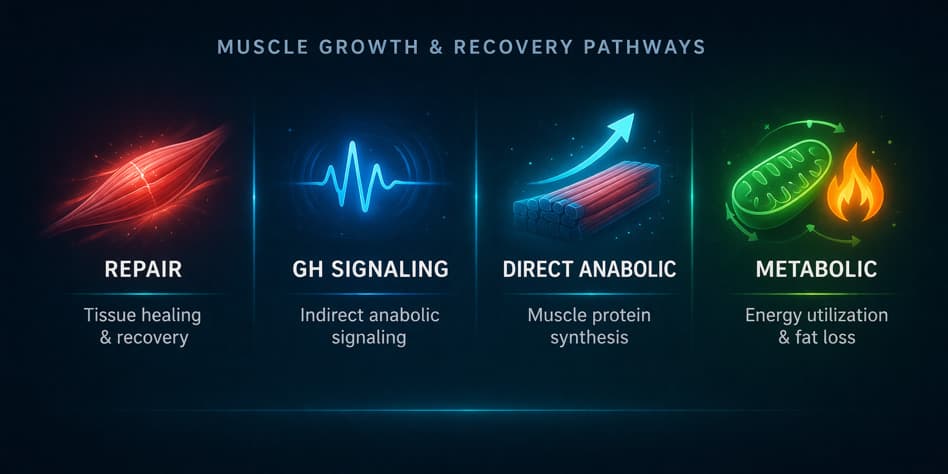
Muscle growth and recovery involve overlapping but distinct biological processes: protein synthesis, satellite-cell activation, angiogenesis, inflammation resolution, and connective-tissue remodeling. Different peptides target different points in that chain, which is why the best peptide for muscle depends on the bottleneck you are trying to solve.

Tissue Repair Peptides (BPC-157, TB-500)

Accelerate healing of muscle, tendon, and ligament injuries through angiogenesis, fibroblast activation, and anti-inflammatory signaling. These do not directly build muscle mass - they enable harder training and faster recovery by resolving injury bottlenecks.

GH Secretagogues (CJC-1295, Ipamorelin)

Stimulate the pituitary gland to release endogenous growth hormone, which elevates IGF-1 levels. Human studies confirm sustained GH and IGF-1 elevation, but translating those hormone increases into measurable lean-mass gains in healthy lifters remains an open question.

Direct Anabolic Peptides (IGF-1 LR3)

Bypass the GH axis and activate IGF-1 receptors on muscle cells directly, promoting protein synthesis, satellite-cell proliferation, and glucose uptake. This is the most potent anabolic mechanism in the guide, but also the narrowest safety margin.

Mitochondrial / Metabolic Peptides (MOTS-c)

Target cellular energy production and exercise capacity rather than direct hypertrophy. MOTS-c activates AMPK and improves glucose metabolism, which may improve endurance and metabolic efficiency.

Muscle growth and recovery pathways comparing repair, GH signaling, direct anabolic signaling, and metabolic support

The 6 Best Peptides for Muscle Growth & Recovery (2026)

1. BPC-157 - Best for Injury Recovery & Tissue Repair

Category: Tissue RepairEvidence: Strong preclinical, minimal human dataRoute: Subcutaneous (or oral)Dose: 250-500 mcg/dayHalf-life: < 30 minutes

BPC-157 (Body Protection Compound-157) is a 15-amino-acid gastric pentadecapeptide with the broadest preclinical evidence base of any tissue repair peptide. A 2025 systematic review in HSS Journal identified 36 studies (35 preclinical, 1 clinical) showing that BPC-157 enhances growth hormone receptor expression, activates angiogenesis pathways such as VEGFR2 and the Akt-eNOS axis, and reduces inflammatory cytokines.

Why it matters for muscle: BPC-157 does not directly build muscle mass. It accelerates healing of muscle tears, tendon strains, and connective-tissue injuries that limit training capacity. In rat models, BPC-157 reversed corticosteroid-impaired muscle healing and restored full functional recovery. A small retrospective human study found that 7 of 12 patients with chronic knee pain reported relief lasting longer than 6 months after a single intra-articular injection.

Key limitation: nearly all data is preclinical. No large randomized controlled trials in humans have been completed. The FDA has not approved BPC-157 for any indication, and WADA prohibits it at all times.

2. TB-500 - Best for Systemic Recovery & Vascular Support

Category: Tissue RepairEvidence: Moderate preclinicalRoute: SubcutaneousDose: 2-5 mg/week loading, 2 mg/week maintenanceHalf-life: Estimated 2-4 hours

TB-500 is a synthetic fragment (Ac-LKKTETQ) of Thymosin Beta-4, a 43-amino-acid protein that regulates actin dynamics, cell migration, and angiogenesis. Where BPC-157 excels at local injury repair, TB-500 provides broader vascular and tissue-regeneration support.

Why it matters for muscle: TB-500 supports the vascular infrastructure that muscle tissue needs to heal. In cardiac injury models, TB-500 reduced infarct size and promoted cardiomyocyte survival. In connective-tissue models, it accelerated tendon and ligament repair with improved collagen-fiber organization. For athletes, that translates to broader recovery support around the injury site and surrounding connective tissue matrix.

Key limitation: most evidence is preclinical. TB-500 is not FDA-approved, remains WADA-prohibited, and its reconstituted stability is shorter than most peptides at roughly 1 to 2 weeks.

3. CJC-1295 + Ipamorelin - Best GH Secretagogue Combination for Sustained Hormone Elevation

Category: GH SecretagogueEvidence: Human PK/PD data individually; no combination trialRoute: SubcutaneousDose: CJC-1295: 1-2 mg/week; Ipamorelin: 200-300 mcg 2-3x/dayHalf-life: CJC-1295 DAC: 5.8-8.1 days; Ipamorelin: about 2 hours

CJC-1295 is a synthetic GHRH analog that stimulates the pituitary to release growth hormone in a sustained, dose-dependent manner. In a 2006 human trial, single subcutaneous injections increased mean plasma GH concentrations 2-fold to 10-fold for more than 6 days and increased IGF-1 1.5-fold to 3-fold for 9 to 11 days. Ipamorelin is a selective ghrelin receptor agonist that induces clean GH pulses without elevating cortisol or prolactin.

Why they are paired: CJC-1295 provides sustained background GH elevation while Ipamorelin delivers acute GH pulses. Together, they aim for a more physiologic GH pattern than either compound alone and remain the most discussed GH-secretagogue pairing in the grey-market peptide space.

Key limitation: while GH and IGF-1 increases are well documented in humans, no clinical trial shows that the combination produces measurable lean-mass gains in healthy resistance-training individuals. Neither compound is FDA-approved, and both are WADA-prohibited.

4. IGF-1 LR3 - Most Potent Direct Anabolic Peptide

Category: Direct AnabolicEvidence: Strong mechanistic data; limited human outcome trialsRoute: SubcutaneousDose: 20-50 mcg/dayHalf-life: 20-30 hours

IGF-1 LR3 (Long Arg3 Insulin-Like Growth Factor-1) is a synthetic IGF-1 analog with a 13-amino-acid N-terminal extension and an arginine substitution at position 3. Those modifications reduce binding to IGF-binding proteins and extend its half-life from minutes to roughly 20 to 30 hours.

Why it matters for muscle: IGF-1 LR3 bypasses the GH axis entirely and directly activates IGF-1 receptors on muscle cells. That triggers the PI3K/Akt/mTOR pathway for protein synthesis and the MAPK pathway for cell proliferation while also activating satellite cells involved in muscle-fiber repair and formation.

Key limitation: the same anabolic potency that makes IGF-1 LR3 attractive also creates risk. Hypoglycemia is the primary acute concern, and sustained IGF-1 elevation raises theoretical concerns about unwanted cell growth. It is not FDA-approved and is prohibited by WADA.

5. MOTS-c - Best for Mitochondrial Energy & Exercise Capacity

Category: Mitochondrial / MetabolicEvidence: Early human data; strong preclinicalRoute: SubcutaneousDose: 5-10 mg/weekHalf-life: Limited human PK data

MOTS-c (Mitochondrial Open Reading Frame of the Twelve S rRNA Type-c) is a mitochondria-derived peptide that activates AMPK, the master metabolic regulator. Unlike the other peptides in this guide, it does not directly target muscle protein synthesis. It instead improves cellular energy handling and glucose metabolism.

Why it matters for muscle: MOTS-c addresses the metabolic substrate layer of performance. By activating AMPK and improving glucose uptake independently of insulin, it may create a more efficient energy environment for training and recovery. That benefit is indirect, but relevant for athletes whose bottleneck is training capacity rather than direct hypertrophy signaling.

Key limitation: MOTS-c is still in the earliest stage of human investigation. Muscle-specific benefits are extrapolated from metabolic pathway data rather than direct hypertrophy trials, and supplier availability is narrower than for the main repair compounds.

6. GHK-Cu - Best for Connective Tissue Remodeling & Recovery Support

Category: Tissue Repair / Anti-InflammatoryEvidence: Moderate human data; extensive gene-expression dataRoute: Subcutaneous or topicalDose: 1-2 mg/day subcutaneousHalf-life: Minutes

GHK-Cu (Glycyl-Histidyl-Lysine Copper) is a naturally occurring tripeptide that declines significantly with age. Computational analysis suggests it modulates more than 4,000 human genes involved in tissue remodeling, collagen synthesis, antioxidant defense, and anti-inflammatory signaling.

Why it matters for muscle: GHK-Cu supports the connective-tissue matrix around muscle fibers, including fascia, tendons, and extracellular matrix. By promoting collagen synthesis, reducing NF-kB-mediated inflammation, and stimulating fibroblast activity, it can improve the structural environment for repair.

Key limitation: its effects on muscle are indirect, and copper-cycling awareness is required because prolonged uninterrupted use may increase copper accumulation risk. It is not FDA-approved for muscle growth, and WADA status should be checked against the current list.

Muscle Growth Peptide Comparison (2026)

FeatureBPC-157TB-500CJC-1295 + IpamorelinIGF-1 LR3MOTS-cGHK-Cu
Primary mechanismAngiogenesis, GH receptor upregulation, anti-inflammatoryActin regulation, cell migration, VEGF angiogenesisGH/IGF-1 axis stimulation through the pituitaryDirect IGF-1 receptor activation via PI3K/Akt/mTORAMPK activation and glucose metabolismCollagen synthesis and gene-expression modulation
Best forInjury recovery and tendon or ligament repairSystemic vascular repair and connective tissueSustained GH elevation and body recompositionDirect muscle hypertrophy and satellite-cell activationExercise capacity and metabolic efficiencyConnective tissue quality and anti-inflammatory support
Evidence tierStrong preclinical; 1 human studyModerate preclinicalHuman PK/PD data for individual compoundsStrong mechanistic; limited human outcome dataEarly human; strong preclinicalModerate human; extensive gene-expression data
RouteSubcutaneous or oralSubcutaneousSubcutaneousSubcutaneousSubcutaneousSubcutaneous or topical
Typical dose250-500 mcg/day2-5 mg/weekCJC: 1-2 mg/week; Ipa: 200-300 mcg 2-3x/day20-50 mcg/day5-10 mg/week1-2 mg/day
Half-life< 30 min~2-4 hr estimatedCJC-DAC: 5.8-8.1 days; Ipa: ~2 hr20-30 hrLimited dataMinutes
FDA statusNot approvedNot approvedNot approvedNot approvedNot approvedNot approved
WADA statusProhibitedProhibitedProhibitedProhibitedProhibitedNot explicitly listed; verify current list
Reconstituted stability3-4 weeks1-2 weeks3-4 weeks each2-3 weeks2-3 weeks2-3 weeks
Common vial sizes5 mg, 10 mg5 mg, 10 mgCJC: 2 mg, 5 mg; Ipa: 5 mg0.1 mg, 1 mg5 mg, 10 mg50 mg, 100 mg
Price range$25-$50 per 5 mg vial$30-$55 per 5 mg vial$35-$70 per combo vial$40-$80 per 1 mg vial$50-$90 per 5 mg vial$25-$45 per 50 mg vial

Best Peptide Stacks for Muscle Growth & Recovery

Stacking peptides from different pathway categories can give broader biological coverage than any single compound. The combinations below are commonly discussed in the research community and align with the dedicated protocol pages referenced in the guide.

Wolverine Stack (BPC-157 + TB-500) - Injury Recovery Foundation

The most widely used tissue-repair stack. BPC-157 provides local angiogenesis and GH receptor upregulation, while TB-500 adds broader vascular support and cell migration. This is the best entry point when active injury or chronic connective-tissue limitation is the training bottleneck.

GLOW Stack (BPC-157 + TB-500 + GHK-Cu) - Tissue Quality Remodeling

Adds GHK-Cu to the Wolverine foundation for collagen synthesis and extracellular-matrix remodeling. It is better suited to chronic tendon and ligament issues where tissue quality is just as important as healing speed.

KLOW Stack (BPC-157 + TB-500 + GHK-Cu + KPV) - Anti-Inflammatory + Repair

Extends the GLOW stack with KPV for an added anti-inflammatory layer. That makes it the broadest repair-oriented stack in the guide when systemic inflammation is compounding recovery issues.

GH Secretagogue + Recovery Stack (CJC-1295/Ipamorelin + BPC-157)

Combines hormonal optimization with tissue repair. CJC-1295/Ipamorelin aims to improve GH and IGF-1 signaling while BPC-157 supports recovery from training-induced muscle damage. No clinical trial has evaluated this combined protocol, so dosing remains community-derived.

Reconstitution & Dosing Quick Reference

The table below uses standard BAC water reconstitution and U-100 insulin syringes. Concentration = total peptide in the vial divided by BAC water added. Dose volume = target dose divided by concentration. Syringe units = volume in mL times 100.

PeptideVial sizeBAC waterConcentrationCommon doseVolumeSyringe units
BPC-1575 mg2.5 mL2,000 mcg/mL250 mcg0.125 mL12.5 U
BPC-1575 mg2.5 mL2,000 mcg/mL500 mcg0.25 mL25 U
TB-5005 mg2.5 mL2,000 mcg/mL2,000 mcg (2 mg)1.0 mL100 U
CJC-1295 (No DAC)2 mg2 mL1,000 mcg/mL100 mcg0.1 mL10 U
Ipamorelin5 mg2.5 mL2,000 mcg/mL200 mcg0.1 mL10 U
IGF-1 LR31 mg1 mL1,000 mcg/mL40 mcg0.04 mL4 U
MOTS-c5 mg2 mL2,500 mcg/mL5 mg2.0 mLFull vial
GHK-Cu50 mg2 mL25,000 mcg/mL1 mg (1,000 mcg)0.04 mL4 U

Supplier Rankings - Who Carries These Peptides

The following suppliers carry muscle growth and recovery peptides and have undergone Finnrick Analytics quality assessment. Ratings reflect testing frequency, sample purity, and contamination risk.

SupplierFinnrick ratingSamples testedCarries muscle peptidesReviewDiscount code
Peptide PartnersA59 across 7 productsBPC-157, TB-500, CJC-1295, IGF-1 LR3, Wolverine Stack blendFull Review
Orbitrex PeptidesAVerified batchesBPC-157, TB-500, CJC-1295, Ipamorelin, MOTS-cFull Review

Peptide Partners is the featured supplier for 2026 in current PepPal data because of the deepest published testing footprint and the availability of pre-blended Wolverine Stack vials. For a wider supplier comparison, use the full supplier directory, then compare against Top 5 Research Peptide Suppliers in 2026 and Best Grey-Market Peptide Supplier.

Red Flags & Green Flags - Evaluating Peptide Quality

Green Flags

01

Finnrick Analytics testing badge or equivalent third-party verification.

02

Batch-specific COA with HPLC purity and mass-spec identity confirmation.

03

Supplier has a 3+ year track record with consistent quality signals.

04

Pricing sits within the normal market range instead of extreme discount territory.

05

Storage, handling, and expiration guidance is clearly provided.

06

Supplier responds to COA and quality-verification questions.

Red Flags

01

No third-party testing data is available.

02

COA comes only from an internal lab with no independent verification.

03

Prices are 50% or more below market average for the same vial size.

04

Sourcing is vague and batch numbers or expiration dates are missing.

05

Product appearance varies dramatically between batches.

06

Support becomes unresponsive when you ask for COA or quality details.

07

Supplier claims pharmaceutical grade without supporting documentation.

For a detailed COA verification walkthrough, read How to Read a Peptide COA.

Pricing Comparison (March 2026)

PeptideCommon vial sizeTypical price rangePer-mg cost
BPC-1575 mg$25-$50$5-$10/mg
TB-5005 mg$30-$55$6-$11/mg
CJC-1295 (No DAC)2 mg$20-$40$10-$20/mg
Ipamorelin5 mg$25-$45$5-$9/mg
IGF-1 LR31 mg$40-$80$40-$80/mg
MOTS-c5 mg$50-$90$10-$18/mg
GHK-Cu50 mg$25-$45$0.50-$0.90/mg
Wolverine Stack pre-blend10 mg blend$45-$75Varies by component
  • - Larger vial sizes usually improve value, with 10 mg vials often providing 15% to 25% better per-mg pricing than 5 mg vials.
  • - Finnrick A-rated suppliers usually command a justified quality premium because of testing depth and purity consistency.
  • - Use code PEPPAL at checkout when eligible.
  • - Prices are dated to March 2026 and can move with supplier inventory and demand.

Side Effects & Safety

Evidence context

None of the peptides in this guide is FDA-approved for muscle growth. Safety data comes from a mix of clinical trials for CJC-1295 and Ipamorelin, preclinical studies for BPC-157, TB-500, IGF-1 LR3, MOTS-c, and community reports for stack usage. Evidence tier matters when weighing confidence in any safety claim.

BPC-157

Generally well tolerated in preclinical studies with no toxic or lethal dose reached across wide animal-model ranges. Community reports mention occasional nausea, headache, and dizziness.

TB-500

Formal safety data is limited. Community reports include mild headache, injection-site irritation, and transient fatigue. Practical risk increases when reconstituted solution is stored too long.

CJC-1295

Human trials at 30-60 mcg/kg reported no serious adverse reactions. Common effects include injection-site reactions, flushing, headache, and transient diarrhea.

Ipamorelin

Human trials showed selective GH release without cortisol or prolactin elevation. Reported side effects include mild headache and water retention.

IGF-1 LR3

This is the narrowest safety margin in the guide. Hypoglycemia is the primary acute concern, and sustained IGF-1 elevation raises theoretical cell-growth questions. Community protocols usually limit use to 4 to 6 week cycles.

MOTS-c

Early-phase human data suggests favorable tolerability, but long-term safety remains thin.

GHK-Cu

Generally well tolerated, but copper-cycling awareness matters. Reconstituted solution may show a blue-green tint because of copper content.

Combined stack safety considerations

01

Introduce compounds one at a time so adverse reactions are easier to isolate.

02

Use the lowest effective dose instead of assuming more is better.

03

Watch for additive effects, especially in people with a cancer history where angiogenesis can be a theoretical concern.

04

Maintain cycling discipline because continuous use increases uncertainty around tolerance and long-term risk.

05

Buy only from Finnrick-verified suppliers to reduce contamination risk in multi-vial protocols.

Frequently Asked Questions - Peptides for Muscle Growth & Recovery

What is the best peptide for muscle growth?

It depends on your goal. For direct muscle hypertrophy and protein synthesis, IGF-1 LR3 has the most potent mechanism because it activates IGF-1 receptors directly on muscle cells via the PI3K/Akt/mTOR pathway. For injury recovery that enables harder training, BPC-157 plus TB-500 has the deepest preclinical evidence. For sustained GH and IGF-1 elevation through the pituitary axis, CJC-1295 plus Ipamorelin is the most studied secretagogue pair. No peptide in this guide is FDA-approved for muscle building.

Are peptides for muscle growth legal?

Research peptides are sold as for research use only in the United States and exist in a grey-market regulatory space. They are not FDA-approved for human use in muscle growth or athletic performance. All peptides in this guide are prohibited by WADA at all times for competitive athletes. Legal status varies by jurisdiction. See the PepPal supplier directory for sourcing context and the grey-market guide for regulatory framing.

Do peptides actually build muscle or just help recovery?

Both, but through different mechanisms. Tissue-repair peptides such asBPC-157 and TB-500 primarily accelerate recovery, allowing harder and more consistent training. GH secretagogues such as CJC-1295 and Ipamorelin elevate growth hormone and IGF-1, which support protein synthesis and body recomposition, though clinical proof of lean-mass gain in healthy lifters is limited. IGF-1 LR3 directly activates anabolic pathways and satellite cells for muscle hypertrophy.

What is the best peptide stack for muscle growth?

For injury-limited athletes, the Wolverine Stack of BPC-157 plus TB-500 addresses the recovery bottleneck. For hormonal optimization plus recovery, CJC-1295 or Ipamorelin plus BPC-157 is the most discussed pairing. For comprehensive tissue repair including connective-tissue quality, the GLOW Stack or KLOW Stack provides the broadest coverage. Stack selection should match your limiting factor rather than assuming one stack is best for everyone.

How do I reconstitute peptides for muscle growth?

Standard reconstitution uses bacteriostatic water injected slowly into the lyophilized vial, followed by gentle rolling instead of shaking. Each peptide requires different water volumes depending on vial size and desired concentration. Use the PepPal reconstitution calculator for custom vial sizes and water volumes, and see the table in this guide for common starting math. For a full walkthrough, read How to Reconstitute Peptides.

How long do peptides take to show results for muscle?

Timeline varies by mechanism. BPC-157 users commonly report improved recovery within 1 to 2 weeks, with structural improvements in injured tissue around 4 to 6 weeks. CJC-1295 plus Ipamorelin may show sleep and energy changes in 2 to 3 weeks with body-composition shifts over 8 to 12 weeks. IGF-1 LR3 activates protein-synthesis pathways quickly, but visible hypertrophy still depends on training over 4 to 6 week cycles.

Are peptides safe? What are the main risks?

Safety profiles vary by compound. BPC-157 and TB-500 show favorable preclinical safety. CJC-1295 and Ipamorelin have human tolerability data at defined dose ranges. IGF-1 LR3 has the narrowest safety margin because of hypoglycemia risk and sustained growth-factor exposure. Across all compounds, the biggest practical risks are contamination from unverified suppliers, incorrect reconstitution math, and poor cycling discipline. Use the calculator and buy only from Finnrick-verified suppliers.

How do muscle peptides compare to steroids or SARMs?

Peptides operate through different mechanisms than anabolic steroids or SARMs. Steroids directly flood androgen receptors with exogenous hormones, while SARMs selectively activate androgen receptors in muscle tissue. Peptides instead support tissue repair, stimulate endogenous GH release, or deliver targeted growth-factor signaling. They generally have milder anabolic effects but fewer androgenic side effects and are not interchangeable categories.

Can women use peptides for muscle growth?

Yes. Unlike androgenic compounds, the peptides in this guide do not work through androgen receptors and do not cause virilization.BPC-157, TB-500, CJC-1295, and Ipamorelin are used by both men and women in the research community. Dosing may still need body-weight adjustment, and IGF-1 LR3 requires the same caution regardless of sex. Always consult a healthcare provider.

Which suppliers carry these peptides with verified quality?

The PepPal supplier directory lists Finnrick Analytics-verified suppliers carrying BPC-157, TB-500, CJC-1295, Ipamorelin, IGF-1 LR3, and pre-blended stacks. Peptide Partners carries the broadest muscle-peptide catalog in current PepPal content, with 59 Finnrick-tested samples across 7 products. Use code PEPPAL at checkout when eligible.

What does the PepPal calculator do?

The PepPal reconstitution calculator takes your vial size, BAC water volume, and target dose and returns the exact injection volume in mL and syringe units for U-100 syringes. It removes manual math errors and works for any peptide, not just the compounds listed in this guide.

Is this medical advice?

No. This article is for educational and informational purposes only. None of the peptides covered are FDA-approved for muscle growth, athletic performance, or bodybuilding. All are prohibited by WADA for competitive athletes. Consult a qualified healthcare provider before considering any peptide compound.

Next Steps

Last updated: March 2026

Disclaimer: This article is for educational purposes only. It is not medical advice. None of the peptides covered is FDA-approved for muscle growth, athletic performance, or bodybuilding. All are prohibited by WADA for competitive athletes. Consult a qualified healthcare provider before considering any compound.
Affiliate note: PepPal may earn referral fees from suppliers listed in this guide. The requested /affiliate-policy route is not present in this repo, so this disclosure is left as plain text for now.