
Finnrick AFinnrick A Supplier
Safety & Side Effects
Trial data review
Retatrutide side effects from the Phase 2 NEJM trial and Phase 3 TRIUMPH-4 topline. Plain-English incidence, dose response, timeline, and research-use quality risks — without the hype.
Quick summary
Retatrutide is a once-weekly investigational drug from Eli Lilly that hits three hunger and energy receptors at the same time: GLP-1, GIP, and glucagon. It is being studied for obesity, type 2 diabetes, sleep apnea, and knee osteoarthritis pain.
Most side effects show up in the stomach and gut. They get more common at higher doses, peak right after each step-up, then ease over a few weeks. The other notable signal is a modest rise in resting heart rate at higher doses.
This page is an educational reference, not medical advice. Retatrutide is not FDA-approved. The only legal way to take it in 2026 is inside an Eli Lilly clinical trial. The FDA explicitly disallowed retatrutide compounding and issued warning letters in September 2025.
Use this as a research-use shopping checklist after reviewing the side-effect and monitoring context. It does not replace dose math, vial instructions, sterile handling guidance, lab interpretation, or medical advice.
PEPPAL applies to eligible supplier checkout links when supported by the supplier.
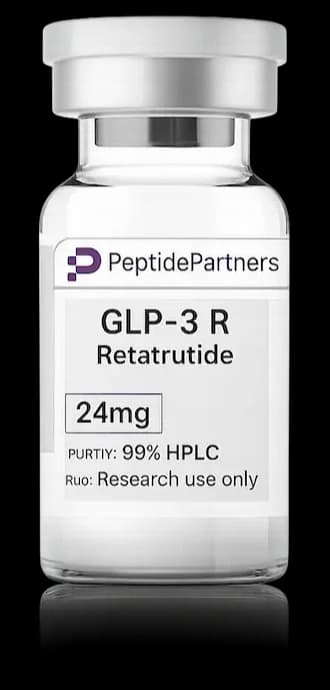
Why choose Peptide Partners?
Disclosure: supply links may earn PepPal a commission at no cost to you.
Use the supplier page, testing documents, and lab plan as the source of truth.
Product match
Confirm the product is retatrutide and that the vial size matches your research plan.
Batch documentation
Match the COA or testing record to the exact product and lot where the supplier makes that available.
Blood work
Arrange baseline and follow-up labs before interpreting GLP-1 research outcomes or side-effect patterns.
Injection supplies
Use fresh syringes, prep pads, and sharps disposal supplies for each handling session.
For reconstitution math, syringe units, and protocol-level instructions, use the retatrutide protocol instead of this shopping checklist.
Across both the Phase 2 NEJM trial (Jastreboff et al., 2023) and the Phase 3 TRIUMPH-4 topline reported by Eli Lilly in December 2025, four gut-related side effects show up the most. They are dose-dependent, meaning higher doses cause them more often.
Most common retatrutide side effects, by dose (Phase 2 NEJM data, 48 weeks)
Side effect
Nausea
1 mg
4 mg
8 mg
12 mg
Placebo
Side effect
Diarrhea
1 mg
4 mg
8 mg
12 mg
Placebo
Side effect
Vomiting
1 mg
4 mg
8 mg
12 mg
Placebo
Side effect
Constipation
1 mg
4 mg
8 mg
12 mg
Placebo
Side effect
Skin sensitivity
1 mg
4 mg
8 mg
12 mg
Placebo
Side effect
Hypersensitivity (rash, itching)
1 mg
4 mg
8 mg
12 mg
Placebo
Numbers are rounded approximations of published Phase 2 results. Phase 3 TRIUMPH-4 (12 mg arm) reported similar headline numbers: nausea ~43%, diarrhea ~33%, constipation ~25%, and vomiting ~21%.
At the 1 mg starting dose, most people felt only mild stomach changes. At 12 mg — the dose used to produce the headline 24% to 28% body-weight reductions — more than half of trial participants felt nausea at some point. Most of it was mild to moderate, and most of it eased without stopping the drug.
About 6% to 16% of participants on retatrutide stopped the drug because of side effects, mostly gut-related. Zero placebo participants stopped for that reason. That stop rate is similar to what semaglutide and tirzepatide trials reported.
This is one of the most-searched questions about retatrutide, and the answer depends on which effect you mean. The Phase 2 trial tracked timing carefully, so we can give specific answers instead of guesses.
When retatrutide side effects start, peak, and fade
Effect
Nausea, diarrhea, vomiting
When it starts
When it peaks
When it eases
Effect
Constipation
When it starts
When it peaks
When it eases
Effect
Heart-rate increase
When it starts
When it peaks
When it eases
Effect
Skin sensitivity
When it starts
When it peaks
When it eases
Effect
Injection-site reactions
When it starts
When it peaks
When it eases
Retatrutide has a half-life of about 6 days. That is why each dose step is held for about 4 weeks in trials — it takes around 2 weeks at any new dose for blood levels to stabilize.
The general pattern: each dose step-up causes a fresh wave of gut symptoms that fade as the body adjusts. The heart-rate change is the one effect that builds up slowly over months and then improves on its own without dropping the dose.
Retatrutide raises resting heart rate at higher doses. In the Phase 2 trial, the average rise at 12 mg was about 6.7 beats per minute, with a typical range of 5 to 10 bpm across the higher dose groups. The rise peaked around week 24 and then drifted back down toward baseline by weeks 36 to 48.
This is slightly larger than the heart-rate rise reported for semaglutide (around 3 to 4 bpm in STEP trials) and tirzepatide (around 3 to 5 bpm in SURMOUNT-1). The glucagon receptor activation is the likely reason — glucagon directly increases cardiac output and heart rate.
Phase 2 trials generally exclude people with significant cardiovascular disease. That means the Phase 2 safety numbers do not automatically transfer to people with heart failure or recent cardiac events.
Beyond the four main gut effects and the heart-rate signal, the published retatrutide trials reported a handful of other issues at lower rates.
Tingling, tenderness, pain when touched, or sensitivity to pressure or heat. Reported at roughly 7% on retatrutide vs. 1% on placebo. Phase 3 TRIUMPH-4 also reported dysesthesia signals in the 9 mg and 12 mg arms.
Redness, swelling, itching, or mild bruising at the site. Usually resolves in a few days. Rotating sites helps.
Rash, hives, or itching at higher doses. Almost always mild and reversible. No anaphylaxis cases in published Phase 2 data.
One acute pancreatitis case at 12 mg in Phase 2. Asymptomatic rises in amylase and lipase were more common. This is a known class concern for all GLP-1 drugs.
Reported at rates similar to placebo in Phase 2. Rapid weight loss is an independent risk factor for gallstones, which makes attribution tricky.
Decreased appetite was reported in around 14% at 12 mg. That is part of the mechanism more than an unwanted effect. Fatigue is occasionally reported but is not a primary signal in the published data.
Everything above is based on pharmaceutical-grade retatrutide given inside a controlled Eli Lilly trial. That is not what is being sold online as 'retatrutide peptide.' The trial product and the research-use product are not the same thing, and the safety data does not automatically transfer.
On September 9, 2025, the FDA issued more than 40 warning letters to telehealth pharmacies and compounders. Retatrutide was specifically named. The FDA stated: 'Retatrutide and cagrilintide cannot be used in compounding under federal law. Additionally, these are not components of FDA-approved drugs and have not been found safe and effective for any condition.'
The FDA also warned about products labeled 'for research purposes' or 'not for human consumption' that are being sold with dosing instructions aimed at human use. The agency said these products are of unknown quality and may be harmful.
If anyone is researching retatrutide outside a Lilly trial, the side-effect profile from the published trials is a baseline only. The actual product may carry additional, unknown risks. PepPal does not endorse using research-use peptides for human consumption.
All three drugs share the same core side-effect pattern (nausea, diarrhea, vomiting, constipation) because they all activate GLP-1. Retatrutide adds GIP and glucagon receptor activity, which slightly changes the safety profile.
Side-effect profile comparison (high-dose arms)
Side effect
Nausea
Semaglutide 2.4 mg
Tirzepatide 15 mg
Retatrutide 12 mg
Side effect
Diarrhea
Semaglutide 2.4 mg
Tirzepatide 15 mg
Retatrutide 12 mg
Side effect
Vomiting
Semaglutide 2.4 mg
Tirzepatide 15 mg
Retatrutide 12 mg
Side effect
Heart rate change
Semaglutide 2.4 mg
Tirzepatide 15 mg
Retatrutide 12 mg
Side effect
Discontinuation for side effects
Semaglutide 2.4 mg
Tirzepatide 15 mg
Retatrutide 12 mg
Numbers approximated from published STEP-1, SURMOUNT-1, and retatrutide Phase 2 and Phase 3 TRIUMPH-4 data. Cross-trial comparisons are imperfect.
Retatrutide's overall side-effect profile is broadly in the same neighborhood as semaglutide and tirzepatide. It tends to run slightly higher on gut symptoms and heart-rate change, mostly because the 12 mg target dose is more aggressive and because glucagon activity adds a heart-rate signal that pure GLP-1 drugs do not have.
PepPal's full comparison guide breaks down efficacy, dosing, and access for all three.
Read the full comparisonMost retatrutide side effects in the trials were mild to moderate and faded with time. A small number are worth treating as same-day medical issues regardless of how the drug was obtained.
Seek medical care the same day for any of these. Do not wait to see if they pass on their own.
Anyone using a research-use product should have an even lower threshold to seek care, because the contents and concentration of those vials are not verified.
As of May 18, 2026, retatrutide is not FDA-approved. It is in Phase 3 development through Eli Lilly's TRIUMPH program. The first major Phase 3 readout, TRIUMPH-4 (obesity plus knee osteoarthritis), was announced in December 2025. The remaining Phase 3 readouts are expected through 2026 and 2027.
FDA approval is anticipated around 2027 under a moderate timeline, assuming the rest of the TRIUMPH readouts support it and Eli Lilly files a New Drug Application.
There is no legal commercial retatrutide. Pharmacies cannot legally compound it. The only legal way to receive real retatrutide in 2026 is to enroll in a Lilly clinical trial. Anything else is research-use only.
If you are looking into retatrutide for your own research, a few PepPal resources can help you reason about it more carefully.
Plain-English breakdown of clinical trials, grey-market access, and the legal status.
Side-by-side weight loss, mechanism, and access comparison for the three big GLP-1-class drugs.
Broader category context — where retatrutide fits among other peptides being researched for weight management.
If you are evaluating any research-use product, this walks through the documentation to look for and the red flags that mean walk away.
The four most common side effects in every published retatrutide trial are nausea, diarrhea, vomiting, and constipation. At the 12 mg target dose in Phase 2, nausea was reported in roughly 60% of participants. Less common effects include skin sensitivity (around 7%), injection-site reactions, mild hypersensitivity, and a modest rise in resting heart rate (around 5 to 7 beats per minute at higher doses).
Gut side effects like nausea and vomiting typically peak in the first 1 to 2 weeks after each dose step-up, then ease over 2 to 4 weeks at the new dose. The heart-rate rise builds up more slowly, peaks around week 24, and drifts back toward baseline by weeks 36 to 48. Injection-site reactions usually resolve in a few days. Some skin sensitivity reports persisted through the full 48-week Phase 2 trial.
Nausea, diarrhea, vomiting, and constipation. These are the same four effects seen across the entire GLP-1 drug class. Retatrutide tends to produce them at slightly higher rates than semaglutide or tirzepatide at the highest studied doses, because the 12 mg target is more aggressive and because the added glucagon activity contributes to a slightly different profile.
Most gut side effects start within the first few days of a dose step-up. Retatrutide has a half-life of about 6 days, which means it takes about two weeks at any new dose for blood levels to stabilize. That is why each dose level is held for about 4 weeks in trials before moving up.
Retatrutide raises resting heart rate at higher doses — about 5 to 7 beats per minute on average at 12 mg. That rise peaked around week 24 in Phase 2 and then drifted back down. Phase 2 also reported mild arrhythmias in 2 to 11% of participants vs. 2% on placebo, none classified as serious. No increase in heart attack or stroke has been reported. Phase 2 was not powered to detect rare cardiovascular events, so the dedicated cardiovascular outcomes trial (TRIUMPH-Outcomes, expected 2027-2028) is still important.
No cancer signal has been reported in published retatrutide trials. The broader GLP-1 class carries a theoretical thyroid C-cell tumor concern based on rodent studies, which is why approved GLP-1 drugs like Wegovy and Mounjaro have a boxed warning. Retatrutide is not approved, so it has no boxed warning yet, but the class concern applies until longer human data is available.
Hair loss was not flagged as a primary signal in the Phase 2 NEJM trial. However, rapid weight loss of any cause can trigger temporary hair shedding (telogen effluvium). Anecdotal reports of thinning hair on retatrutide are most likely tied to fast weight loss rather than to the drug itself. The same pattern shows up with semaglutide and tirzepatide.
In clinical trials, slower titration helps. The Phase 2 trial showed that starting at 2 mg and stepping up more slowly produced fewer gut side effects than starting at 4 mg. Holding each dose for the full 4 weeks before stepping up — instead of rushing to the next dose — also reduced symptoms. PepPal does not publish personal-use dosing protocols; for protocol-focused research, see Peptide Dosing Protocols.
No. As of August 2026, retatrutide is still in Phase 3 trials through Eli Lilly's TRIUMPH program. FDA approval is anticipated around 2027 if the remaining Phase 3 readouts support it. The FDA has explicitly said retatrutide cannot be legally compounded and has issued more than 40 warning letters to compounders and telehealth pharmacies in September 2025.
Yes. Anything sold as 'retatrutide peptide' online is research-use only and not FDA-reviewed. The published Phase 2 and Phase 3 safety data is based on Eli Lilly's exact trial product, which is not what online sellers are shipping. Quality risks include wrong identity, wrong concentration, impurities, and improper shipping or storage. The FDA has warned consumers not to purchase these products. If you are evaluating any research-use supplier, see PepPal's supplier reviews and COA reading guide.
No. This page is an educational summary of the published retatrutide trial data and current FDA status. It is not medical advice and is not a recommendation to take retatrutide. The only legal way to receive real retatrutide in 2026 is through an Eli Lilly clinical trial.
Preferred supplier
Peptide PartnersNeed peptides? Start with a verified supplier.
PepPal's recommended source with current discount access and established testing standards.