FeaturedFeatured Supplier
Growth Hormone Peptides
Research-use only
CJC-1295 and Ipamorelin are two lab-made peptides often combined to raise the body's own growth hormone. Here is what each one does, what the evidence supports, and where the rules stand in 2026.
Quick summary
CJC-1295 and Ipamorelin are two man-made peptides that researchers often combine. Both tell the body to release more of its own growth hormone, called GH. They do this through two different signals, which is why they are studied together. They do not add growth hormone from outside the body. Instead, they nudge the pituitary gland — a pea-sized gland at the base of the brain — to make and release more on its own.
This page is educational and is not medical advice. CJC-1295 and Ipamorelin are not FDA-approved. Talk to a licensed clinician before making any health decision.
Use this as a research-use shopping checklist before comparing vial math, storage, and batch documentation. It is not dosing guidance, sterile handling training, or medical advice.
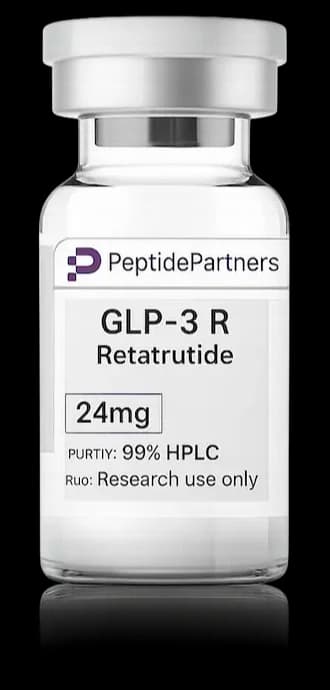
PEPPAL applies to eligible Peptide Partners checkout links when supported by the supplier.
Why choose Peptide Partners?
Disclosure: supply links may earn PepPal a commission at no cost to you.
Keep the peptide vial, reconstitution supplies, and lab context separate so each part is easy to check.
Product match
Confirm the product is CJC-1295 no DAC plus Ipamorelin, not CJC-1295 with DAC or a single-compound vial.
Batch documentation
Match the COA or testing record to the exact product and lot where the supplier makes that available.
Reconstitution supplies
Plan bacteriostatic water, sterile syringes, alcohol swabs, cold storage, and sharps disposal before handling a lyophilized vial.
Monitoring context
Growth-hormone secretagogue research is usually interpreted alongside IGF-1, fasting glucose, and broader metabolic markers.
CJC-1295 is a copy of growth hormone-releasing hormone, or GHRH. GHRH is the natural signal your brain sends to start GH release. CJC-1295 mimics that signal, but it can last much longer in the body than the natural version. Think of it as the part that keeps the GH signal switched on for a while.
Ipamorelin is a short peptide made of five amino acids. It works on a separate switch called the ghrelin receptor. When it flips that switch, the pituitary releases a quick pulse of GH. Researchers call Ipamorelin "selective" because, in early studies, it raised GH without raising stress hormones like cortisol or prolactin (Raun et al., 1998).
The two peptides are combined because they push GH release in different ways. CJC-1295 acts like a steady, longer push. Ipamorelin acts like a fast, short pulse. People often call this a "pulse and sustain" pattern. The goal is to copy the body's natural GH rhythm a little more closely than either one alone.
Two peptides, two different jobs
Peptide type
CJC-1295
Ipamorelin
Main job
CJC-1295
Ipamorelin
Receptor
CJC-1295
Ipamorelin
Simple role
CJC-1295
Ipamorelin
Clinic and user reports describe a larger combined release, but no human trial has measured the exact pair.
One of the most confusing parts of this topic is "DAC." DAC stands for Drug Affinity Complex. It is an add-on that makes CJC-1295 stick to a blood protein called albumin. That makes it last much longer in the body.
CJC-1295 with DAC has a very long half-life. In one human study, GH and IGF-1 stayed raised for several days after a single shot (Teichman et al., 2006). CJC-1295 without DAC is often sold as "Mod GRF 1-29." It clears the body in minutes. Many people who buy a "CJC-1295 + Ipamorelin" blend are actually using the no-DAC form. The two are not the same, and mixing them up is a common mistake.
DAC vs no-DAC at a glance
Half-life
With DAC
No DAC (Mod GRF 1-29)
GH pattern
With DAC
No DAC (Mod GRF 1-29)
Common blend partner
With DAC
No DAC (Mod GRF 1-29)
Human data
With DAC
No DAC (Mod GRF 1-29)
If a product label does not say which form it is, that is a reason to ask before buying.
In the research-use peptide market, this pair is discussed for a few main reasons. People connect it to recovery, body composition, and sleep. These ideas come from the known effects of growth hormone, plus user reports. They are not the same as proven results in trials.
Here is the honest split. Growth hormone itself is well studied. But this specific peptide pair has very little direct human evidence for these goals. Popularity is high. Proof is thin. Both things are true at the same time.
Start with the strongest evidence. CJC-1295 (the DAC form) was tested in two small, placebo-controlled human studies in 2006. A single shot raised GH by about 2 to 10 times for six or more days. IGF-1, a marker tied to GH, stayed up for 9 to 11 days. No serious side effects were reported (Teichman et al., 2006).
Ipamorelin's main evidence is older and mostly from animals. The 1998 study that named it showed clean GH release without raising cortisol or prolactin (Raun et al., 1998). It reached early human testing but was never developed into an approved drug, and a company trial for a gut condition was stopped.
As of August 2026, no published human randomized trial has tested the CJC-1295 plus Ipamorelin combination. The "synergy" you read about is based on how each peptide works alone, plus clinic and user reports — not a controlled trial of the pair.
People often compare this pair to other growth-hormone peptides. They are related, but not the same.
CJC-1295 / Ipamorelin vs nearby compounds
Compound
Sermorelin
Type
How it differs
Compound
Tesamorelin
Type
How it differs
Compound
MK-677 (ibutamoren)
Type
How it differs
Compound
HGH (somatropin)
Type
How it differs
These are not interchangeable. Each has its own evidence and risk profile.
Most reported effects are mild and tied to higher GH or IGF-1. Common reports include water retention, tingling or numbness in the hands, headache, and tiredness. Redness or itching at the injection site can also happen.
There are also risks that need real monitoring. Higher IGF-1 over time could affect blood sugar and insulin sensitivity. People with a history of cancer are usually told to avoid GH-raising compounds, because GH and IGF-1 can affect cell growth. These concerns come from GH biology, not from long trials of this exact pair.
Here is the status as of August 2026. Neither CJC-1295 nor Ipamorelin is an FDA-approved drug. Neither one finished the full approval process.
Their compounding status has moved a lot. In late 2023, the FDA placed many peptides, including these two, on a restricted "Category 2" bulk list. In September 2024, both were removed from Category 2 after the nominations were withdrawn. In April 2026, the FDA reorganized its lists again, and these peptides were not placed on the cleared "Category 1" list. The FDA also scheduled advisory committee meetings in 2026 to keep reviewing peptide compounding.
Bottom line: the rules are unsettled, and most CJC-1295 and Ipamorelin sold online is labeled research-use only. For the latest, see our FDA Category 2 update.
If you are researching suppliers, focus on testing, not hype. Look for a recent third-party certificate of analysis (COA) that matches the exact batch. Independent labs like Janoshik test peptide purity. Match the lot number on the vial to the report.
Be careful with words like "safe," "medical grade," or "guaranteed." Those are marketing terms, not proof. Confirm the current supplier policy and testing before any order. You can compare options on our Suppliers hub.
PepPal does not give personal dosing instructions on this page. For vial math and unit conversions, use the calculator, and talk to a licensed clinician for personal guidance.
In the research-use market, the pair is discussed for recovery, body composition, and sleep, based on the known effects of growth hormone and on user reports. There is little direct human evidence for these specific goals with this combination, so popularity is higher than proof.
No. As of August 2026, neither compound is FDA-approved, and the 503A compounding rules were still unsettled. Both were removed from the FDA's restricted Category 2 list in September 2024 but were not placed on the cleared Category 1 list in the April 2026 reorganization. See our FDA update for current details.
DAC (Drug Affinity Complex) makes CJC-1295 last for days, so it can be used less often. The no-DAC form, often sold as Mod GRF 1-29, clears in minutes. Most CJC-1295 plus Ipamorelin blends use the no-DAC form. They are not the same compound.
Each peptide has its own data, but no published human randomized trial has tested the exact combination. CJC-1295 (DAC) was studied in two small 2006 human trials, while Ipamorelin's evidence is mostly preclinical from 1998 onward.
Commonly reported effects include water retention, tingling in the hands, headache, fatigue, and injection-site redness. Longer-term, higher IGF-1 may affect blood sugar, and GH-raising compounds are usually avoided by people with a cancer history. This is not a complete safety list.
HGH (somatropin) adds growth hormone directly. CJC-1295 and Ipamorelin instead signal your own pituitary to release more GH, which is why suppression tends to be lower. HGH is stronger and more tightly regulated.
Sermorelin is also a GHRH analog, but it is shorter-acting and closer to natural GHRH, and it was once an FDA-approved product. CJC-1295 lasts longer, especially in the DAC form. Ipamorelin is a separate type of peptide that adds a fast GH pulse.
PepPal does not publish personal dosing protocols. Research papers used weight-based doses, and community blends are often labeled around 5 mg plus 5 mg per vial. For vial math and unit conversions, use the calculator, and speak with a licensed clinician for personal guidance.
Look for a recent third-party COA that matches the exact batch, and confirm the lot number on the vial matches the report. Independent testing labs like Janoshik report purity. Avoid products that rely on words like "safe" or "guaranteed" instead of test data.
No. This is an educational research summary, not medical advice or a treatment plan. CJC-1295 and Ipamorelin are not FDA-approved. Talk to a qualified clinician before making any health decision.
Preferred supplier
Peptide PartnersNeed peptides? Start with a verified supplier.
PepPal's recommended source with current discount access and established testing standards.