
By Garret Grant · Founder, PepPal · Last updated August 2026
How to Store Peptides: Shelf Life, Fridge vs. Freezer & the 30-Day Myth
Complete peptide storage guide: lyophilized vs reconstituted shelf life, fridge vs freezer rules, BAC water 28-day limit, and what Janoshik testing actually shows.
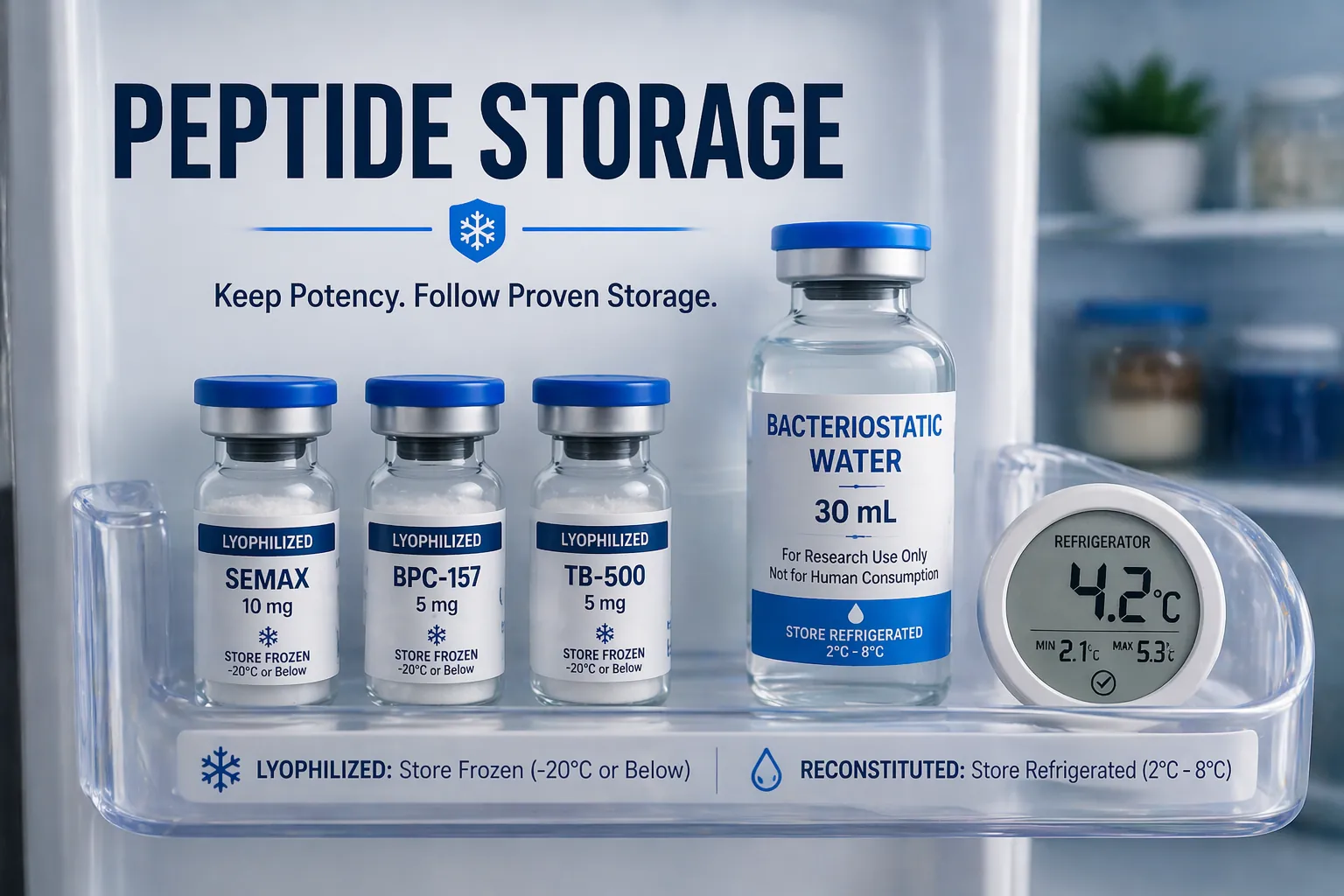
Quick Answer
Lyophilized (freeze-dried) peptide powder is durable: store it sealed in the freezer at –20 °C for years, the fridge at 2–8 °Cfor months, or at room temperature for a few weeks if you'll use it soon [1][2]. Once you reconstitute with bacteriostatic water, it goes in the fridge only - never the freezer in the original vial - and you have roughly 28–30 days before either microbial risk or BAC water preservative breakdown becomes the limiting factor [3][4]. The widely repeated "30-day rule" is partly a BAC water rule, not a peptide rule. Janoshik Analytical's testing data shows the peptide molecule itself is far more stable than the community usually claims [5].
This guide covers every storage scenario you'll actually face, with the math, the temperatures, and the evidence behind each rule.
Use this as a practical checkout checklist: start with a reviewed supplier, add baseline blood testing, then gather the common supplies you need before ordering.
Vetted Supplier Shopping Cards
Peptide Partners
At-Home Blood Test
More Supplies
Disclosure: supply links may earn PepPal a commission at no cost to you.
Companion Supplies & Routine Support
Why Storage Matters More Than Most People Think
You can buy the highest-purity peptide on the market, follow your reconstitution math perfectly (use the free PepPal calculator for that), and still get nothing from your protocol - because storage failures are silent. A degraded peptide solution looks identical to a fresh one. Cloudiness shows up only after major contamination. Potency loss doesn't change the color. The only honest signals you have are the temperature, the date, and the math.
I built this guide because the existing storage advice on the internet is a mess of three contradictions: pharmaceutical lab guidance written for grams of bulk peptide, supplier blog content written to sell more vials, and forum folklore that's been repeated so many times it sounds like fact. I cross-checked the conventional rules against Janoshik Analytical's published testing positions, the FDA-registered Hospira bacteriostatic water label, and the underlying peer-reviewed lyophilization literature [1][2][3][5][6]. Some conventional rules hold up. Several don't. I've flagged each one.
If you're new to peptides entirely, start with How to Reconstitute Peptides and How to Read a Peptide COA - this guide picks up where reconstitution ends.
The Two Forms You're Storing - and Why They Behave Differently
Every peptide you'll ever handle exists in one of two states: lyophilized (freeze-dried powder, the form vials ship in) or reconstituted (mixed with bacteriostatic water into an injectable solution).
Lyophilized peptides are tough. Freeze-drying removes nearly all water - typically below 1% residual moisture - which essentially halts the chemical reactions that destroy peptides over time: hydrolysis, deamidation, oxidation, aggregation [6]. The peptide is locked into an amorphous "glassy" solid where molecular movement is so slow that degradation barely happens. Properly lyophilized peptides held at –20 °C have demonstrated stability for 3–5 years, and at –80 °C, melanoma peptide vaccines have stayed stable for 5 years in published studies [2][7].
Reconstituted peptides are fragile. Once water is reintroduced, every degradation pathway turns back on. Hydrolysis cleaves peptide bonds. Methionine, cysteine, and tryptophan residues oxidize on contact with air. Bacterial contamination becomes possible at every needle puncture. Even refrigerated and protected from light, reconstituted peptides last weeks, not years [3][8].
The single most important storage rule follows from this: the colder and drier you keep your peptide beforereconstituting it, the longer your total usable window. Once it's in solution, the clock starts and you can't stop it.
Lyophilized (Powder) Storage - The Easy Form
| Storage Location | Temperature | Realistic Shelf Life | When to Use |
|---|---|---|---|
| Freezer | –20 °C / –4 °F | 3–5 years; up to 5+ years for vaccine-grade peptides at –80 °C [2][7] | Long-term inventory, batches you bought ahead, peptides you'll use over many months |
| Refrigerator | 2–8 °C / 36–46 °F | 12–18 months for most peptides [1][8] | Active inventory you'll work through over the next 6–12 months |
| Room temperature | 20–25 °C / 68–77 °F | 1–4 weeks; potentially months for stable sequences [1][5][7] | Short-term holding before you reconstitute; transit from a supplier |
A few non-obvious details worth knowing:
Don't open a cold vial until it's warmed up. When you pull a vial straight from the freezer or fridge and pop the cap, condensation forms on the cold rubber stopper and the powder cake. That moisture is exactly what your dry peptide needs to start degrading. Let the vial sit at room temperature in its packaging for 15–30 minutesbefore any handling, and always store in a desiccator or sealed container with desiccant if you're stockpiling [1][9].
Skip the frost-free freezer. Frost-free units cycle through brief defrosting periods that swing the internal temperature meaningfully. A standard chest freezer or a small dedicated peptide freezer holds temperature far more consistently [1].
Keep it dark.Light exposure - UV especially - accelerates oxidation of light-sensitive amino acids. Original packaging usually handles this, but if you're rotating vials in and out, keep them in a closed box, an opaque case, or wrapped in foil [9][10].
Sequence-specific caveats.Peptides containing methionine, cysteine, or tryptophan are oxidation-prone and should be stored colder for shorter use windows. Peptides with asparagine or glutamine can deamidate even in dry form. If you're working with GHK-Cu or other copper peptides, the copper-binding chemistry adds another stability variable - refrigerate the lyophilized form rather than freezing it once you're past long-term storage and into active use [10].
Reconstituted (Liquid) Storage - Where Most People Mess Up
This is the harder section. There are three different timers running on a reconstituted vial, and most people only track one of them.
Timer 1: The Bacteriostatic Water Timer (28 Days, FDA-Backed)
Hospira - the dominant manufacturer of pharmaceutical bacteriostatic water in the US - states in their FDA labeling that bacteriostatic water for injection should be discarded within 28 days of first puncture [3][4]. The 0.9% benzyl alcohol preservative inhibits bacterial growth, but its protective concentration and effectiveness decline with each needle puncture, exposure to air, and time elapsed.
This 28-day window is the original source of the famous "30-day rule" - and it's an FDA-grade limit on the water, not a chemical degradation limit on the peptide. It applies whether you reconstituted on day 1 of opening the BAC water vial or day 25.
When I ran the math against Hospira's labeling and the USP/CDC guidance for multi-use vials, the practical implication is clear: if you reconstitute a peptide on day 20 of your BAC water vial, your peptide solution inherits a remaining 8-day BAC-driven sterility window - even if the peptide itself would last longer. Either reconstitute early in your BAC water vial's life, or open a fresh BAC water vial when you mix.
Timer 2: The Peptide Stability Timer (Often Longer Than You Think)
Here's where conventional storage advice and Janoshik Analytical's data diverge sharply. The repeated forum claim is "all reconstituted peptides die after 30 days." Janoshik's lab data - the most-tested gray-market peptide lab in the world, with roughly 100 peptide tests per day - does not support that claim [5][11].
In his "Peptide Myths Busted" interview on GLP-1 Forum and across multiple podcast appearances, Janoshik founder Peter Magic has stated several positions that directly challenge conventional storage folklore [5][11][12]:
- Properly lyophilized peptides remain stable for years refrigerated and over a decade frozen - far longer than the community typically assumes.
- Room temperature degradation of lyophilized peptide is typically 2–3%, not the catastrophic loss community myths suggest.
- Shaking or injecting BAC water directly into a vial does not damage peptides - Janoshik tested rHGH this way and saw no measurable degradation. The "gentle swirl only" rule is not supported by his lab data.
- Reconstituted peptides are best used within about 4 weeks under refrigeration. After that point, microbial contamination is the bigger concern than chemical breakdown of the peptide molecule itself.
- For European researchers, sterile water (immediate use) is often a reasonable substitute for BAC water - BAC water is mainly for sterility, not peptide preservation.
I want to be precise about what this means and doesn't mean. Janoshik's conclusion is not"your peptide lasts forever." His conclusion is that the 30-day discard rule is driven mostly by microbial safety from repeated needle punctures, and the underlying peptide molecule is more chemically stable than supplier marketing implies. For most users, the practical guideline stays the same - use within about 28–30 days - but the reason for that limit is sterility, not chemistry.
The exception: peptides with known instability - copper peptides, methionine/cysteine-containing sequences, IGF-1 LR3, and some growth hormone secretagogues - chemically degrade faster in solution and warrant tighter timelines [13][14].
Timer 3: The Microbial Risk Timer (Resets With Every Puncture)
Every time you push a syringe through the rubber stopper, you create a microscopic moment where the seal is breached. The benzyl alcohol in BAC water is bacteriostatic - it inhibits bacterial reproduction but does not kill bacteria already introduced [4][15]. Over 30 days and 30+ punctures, the cumulative contamination risk grows even when each individual puncture is sterile.
This is why pharmaceutical handling requires alcohol-swabbing the stopper before every puncture, single-use sterile needles, and never finger-touching the rubber. It's also why most clinical multi-dose vial guidance settles on the same 28-day limit regardless of what's dissolved inside.
Reconstituted Storage Quick Rules
| Storage Location | Temperature | Realistic Window | Notes |
|---|---|---|---|
| Refrigerator (the right answer for the original vial) | 2–8 °C / 36–46 °F | 28–30 days for most peptides; 28 days hard cap from BAC water sterility | Back of the fridge, not the door. Upright. Protected from light. |
| Freezer (original vial) | –20 °C | Avoid for the working vial | Freezing the BAC water can destabilize the benzyl alcohol distribution and risks vial cracking. |
| Freezer (aliquoted into sterile cryovials) | –20 °C or –80 °C | Months, but each thaw cycle = potency loss | Acceptable advanced strategy - see "Aliquoting" below. |
| Room temperature | 20–25 °C | Hours, not days | Avoid. If you accidentally left a vial out overnight under 24 hours, it's likely fine; over 24 hours, expect potency loss. |
Bacteriostatic Water Storage - The Often-Skipped Step
BAC water is a peptide-storage variable in its own right, and it has its own storage rules.
Unopened BAC water vials carry a 2–3 year manufacturer shelf life and should be stored at controlled room temperature (20–25 °C / 68–77 °F), away from light, and never frozen [3][16]. Freezing can cause uneven benzyl alcohol distribution after thawing - pockets of higher and lower preservative concentration - which defeats the multi-dose protection.
Once punctured, the 28-day clock starts. Refrigerate the opened vial (2–8 °C is fine post-puncture), keep it upright to minimize stopper contact with the solution, and write the puncture date on the vial with a permanent marker the moment you open it. This single habit eliminates the most common BAC-related mistake in the entire workflow: squinting at a vial three weeks later trying to remember when you opened it.
Pharmaceutical-grade matters. Hospira (a Pfizer subsidiary) is the FDA-registered, cGMP-manufactured benchmark for US bacteriostatic water [3]. Generic or compounded BAC water from gray-market sources varies in benzyl alcohol concentration, sterility verification, and endotoxin control. For research integrity and reproducibility, Hospira-grade is the right baseline.
The 30-Day Myth - What It Is and Isn't
The "30-day rule" you've seen repeated everywhere on the internet has three different sources tangled together:
- Hospira's BAC water 28-day discard guidance (FDA-labeled, accurate, applies to the diluent, not the peptide) [3].
- Pharmaceutical multi-dose vial conventions (USP/CDC-derived, microbial safety driven, 28 days) [15].
- Folk wisdom that "the peptide goes bad at 30 days" (often vendor-driven, not supported by Janoshik's testing data, and confused with items one and two) [5].
The accurate version of the rule: For most peptides, stop using a reconstituted vial at about 28 days because the BAC water sterility is no longer guaranteed, not because the peptide molecule has chemically died.
That distinction matters for two reasons. First, it tells you that storage temperaturediscipline (cold, dark, sealed) matters more than obsessing over a calendar. Second, it tells you that for a fresh, low-puncture-count vial - say, one you mixed yesterday from a fresh BAC water vial and barely used - the 30-day rule is conservative, and Janoshik's testing suggests the peptide itself is fine well past that point. The microbial risk is what closes the window.
What it does notmean: "I can use my reconstituted GHK-Cu for three months." Copper peptides chemically degrade faster than the average sequence. It does not mean "skip BAC water." It does not mean "leave it on your counter."
It does mean: the peptide molecule is more durable than the marketing suggests, and the limiting factor is almost always sterility - which puts the practical window at the same 28–30 days regardless.
Should You Freeze Reconstituted Peptides?
This is where I see the most contradictory advice in the niche, so I'll be specific.
The original vial after reconstitution: no, do not freeze. Two problems. First, the benzyl alcohol in BAC water can redistribute unevenly when frozen and thawed, weakening the preservative protection. Second, freezing and thawing the same vial repeatedly - once for each dose - is a textbook way to destroy peptides through ice-crystal damage [17][19][20].
Aliquoted into sterile single-use cryovials before freezing: yes, with care. This is the advanced storage strategy used by researchers who reconstitute large vials and need to extend usable life beyond 30 days. The protocol:
- Reconstitute the full vial with BAC water at your target concentration.
- Immediately divide into single-use aliquots (for example, one week's worth of doses per vial) in sterile glass cryovials.
- Freeze each aliquot at –20 °C or –80 °C.
- Thaw one aliquot at a time in the refrigerator (slow, controlled thaw).
- Never refreeze a thawed aliquot.
Single-cycle freeze-thaw is well-tolerated by most peptides [19][20]. The damage compounds with repeated freeze-thaw cycles - published estimates put the per-cycle loss at roughly 2–15% depending on the sequence [17][19]. For most users with a single vial they'll finish in a month, aliquoting is overkill. For users with expensive long-cycle compounds (retatrutide, tirzepatide bulk vials), aliquoting can stretch usable life from weeks to months.
Special Cases - Peptides That Don't Follow the Standard Rules
Not every peptide stores the same way. Here are the ones that warrant tighter handling:
Copper peptides (GHK-Cu, AHK-Cu). The copper-peptide bond is sensitive. Reconstituted GHK-Cu should be refrigerated only - not frozen - and used closer to 28 days than 45. Room temperature stability drops to 48–72 hours before measurable copper dissociation begins [13]. See the GHK-Cu protocol for full handling notes.
TB-500 (Thymosin Beta-4). Reconstituted stability is on the shorter end of the spectrum - the Wolverine Stack guide and the TB-500 protocol both flag TB-500 as the limiting compound when it's stacked with longer-stable peptides like BPC-157.
IGF-1 LR3. Insulin-like growth factor variants are temperature- and pH-sensitive. Refrigerate strictly, and consider aliquoting if the cycle exceeds 4 weeks [14].
GLP-1s (semaglutide, tirzepatide, retatrutide). Generally well-behaved at fridge temperatures. The pharmaceutical Ozempic/Mounjaro/ Zepbound pens carry FDA-labeled in-use stability of several weeks at refrigerated or controlled room temperature, and Janoshik's testing suggests the underlying peptide molecules are quite stable. The 28-day BAC water limit is still the binding constraint for gray-market reconstituted vials. For full protocols see semaglutide, tirzepatide, and retatrutide.
BPC-157. One of the more forgiving peptides. Refrigerated reconstituted BPC-157 commonly stays stable past 30 days in community testing - but again, microbial risk closes the window first. See the BPC-157 protocol.
What to Do When Things Go Wrong
Power outage under 4 hours
If the fridge stayed closed, peptides are almost certainly fine. Continue using.
Power outage 4–12 hours
Peptides may have warmed to room temperature briefly. If they look clear and normal, continue using but consider tightening your discard timeline.
Power outage over 12 hours
Discard reconstituted vials. Lyophilized vials likely survive - re-refrigerate them and proceed.
Vial left out overnight
Under 24 hours at typical room temperature, most peptides retain meaningful potency. Over 24 hours, expect partial loss - usable for less critical applications, discard for important protocols.
Vial appears cloudy or has visible particles
Discard. This indicates either contamination or peptide aggregation, and neither is salvageable.
Color change
GHK-Cu reconstituted is naturally blue/green from the copper. For most other peptides, any color shift is a warning sign - discard.
You forgot when you reconstituted it
Default to discarding at the 28-day mark from the BAC water puncture date if you don't know the reconstitution date. Always label vials at the moment you mix.
Storage Supply Recommendations
You don't need much hardware, but a few items meaningfully reduce error rates. See the full peptide injection supplies guide for product-level recommendations. The essentials:
- Permanent marker for dating every vial at puncture or mix time.
- Small sealed storage case or container to keep vials upright in the fridge and protected from light.
- Dedicated fridge zone at the back of the fridge, not the door.
- Desiccant packs for any lyophilized inventory you're storing more than a few weeks.
- Sharps container for used syringes - not a storage item, but the storage workflow ends here.
Common Mistakes - Red Flags I See Repeatedly
Storing in the door of the fridge
The door cycles through 5–10 °C swings every time you open it. Back of the fridge is 2–4 °C steady. Move your peptides.
Freezing reconstituted vials in the original BAC water solution
Damages the benzyl alcohol distribution and risks vial cracking. If you must freeze, aliquot first.
Reusing BAC water vials past 28 days
The preservative effectiveness drops, and contamination risk rises. Open a fresh vial.
Skipping the puncture date label
This single oversight causes more "should I throw this out?" anxiety than any other storage habit. Two seconds with a marker eliminates it.
Pre-loading syringes for the week
Peptides can adsorb to plastic syringe walls over time, reducing your effective dose. Draw doses immediately before use. [13]
Trusting "looks fine"
Peptide degradation is invisible to the eye. Trust the temperature log and the date, not the appearance.
Frequently Asked Questions
How long do reconstituted peptides last in the fridge?
For most peptides, plan for 28–30 days of refrigerated stability at 2–8 °C. The hard limit comes from the FDA-labeled 28-day window for bacteriostatic water once punctured - not from the peptide molecule itself, which Janoshik Analytical's testing data suggests is more chemically stable than commonly believed. Copper peptides and IGF-1 variants warrant tighter timelines closer to 21–28 days. Use the PepPal calculator to plan your dose schedule against this window.
Can you freeze lyophilized peptides?
Yes, and you should for long-term storage. Lyophilized peptides stored at –20 °C remain stable for 3–5 years, and at –80 °C, peer-reviewed peptide vaccine studies have demonstrated stability out to 5 years or longer. Freezing the dry powder is the gold standard for any inventory you won't use within a few months. Avoid frost-free freezers because of temperature cycling.
Can you freeze reconstituted peptides?
The original vial after reconstitution: no. Freezing reconstituted BAC water solutions can redistribute the benzyl alcohol unevenly and risks cracking the vial. Aliquoted into single-use sterile cryovials before freezing: yes, with care - single-cycle freeze-thaw is tolerated, but never refreeze a thawed aliquot. Each cycle costs roughly 2–15% potency depending on the peptide.
What is the 30-day rule and is it real?
The 30-day rule is real but commonly misunderstood. The actual source is Hospira's FDA-labeled 28-day discard window for bacteriostatic water once punctured. It's a sterility limit on the diluent, not a chemical death sentence on the peptide. Janoshik Analytical's testing positions suggest the peptide molecule itself is often stable longer than 30 days, but microbial risk from repeated needle punctures still closes the window at the same 28-day mark in practice. For new readers: stop at about 28–30 days regardless.
How long does bacteriostatic water last after opening?
Per Hospira's FDA labeling and USP/CDC multi-dose vial guidance, 28 days from first puncture, then discard. Refrigerate after opening, keep upright, and write the puncture date on the vial. Unopened BAC water carries a 2–3 year manufacturer shelf life at controlled room temperature.
Do peptides need to be kept in the dark?
Yes. UV and visible light exposure accelerates oxidation of light-sensitive amino acid residues like tryptophan, tyrosine, methionine, and cysteine. Original packaging usually handles this. If you're rotating vials in and out of storage, keep them in an opaque case, foil-wrapped, or in the back of the fridge in a closed box.
What temperature is safe for shipping peptides?
Lyophilized peptides tolerate room-temperature shipping for 1–4 weeks, longer for stable sequences. Suppliers use insulated packaging with ice packs not because the peptide will die in 48 hours of warmth, but because consistent cold-chain handling protects against worst-case heat exposure during transit. When peptides arrive, refrigerate or freeze them immediately.
Should I store peptides in glass or plastic vials?
Original glass vials from your supplier are the right answer - they're sterile, sealed, and chemically inert. If you aliquot for freezing, use sterile glass cryovials rather than plastic to minimize peptide adsorption to vessel walls.
Does the freezer ruin reconstituted peptides because of ice crystals?
Single-cycle freezing of an aliquoted, sterile peptide solution causes minimal damage - most peptides tolerate one freeze fine. The myth comes from people freezing and thawing the same vial repeatedly to draw doses, which compounds ice-crystal damage and degrades the peptide 5–15% per cycle. The rule is freeze once, thaw once - never refreeze what's been thawed.
What if I left my reconstituted peptide out overnight?
Under 24 hours at typical room temperature, the peptide likely retains most of its potency for non-critical use. Over 24 hours, expect meaningful potency loss and consider discarding for any protocol where dose accuracy matters. Visible cloudiness or particles means discard immediately, regardless of timeline.
Can I store peptides in a wine fridge or beverage cooler?
Yes, if it holds steady 2–8 °C. Wine fridges and small beverage coolers actually outperform many kitchen refrigerators for peptide storage because they hold temperature more consistently and aren't opened as often. Add a small thermometer and verify the temperature for a week before trusting it.
Do I need a separate freezer for peptides?
Not necessary, but helpful. A standard chest freezer or a small dedicated unit holds temperature better than a frost-free upright. If you're using a kitchen freezer, keep peptides in the back, not in the door, and avoid frost-free models when possible.
How do I know if my peptide is still good?
You usually can't tell visually - degradation is silent. The honest answer: trust the date and the temperature. If you've kept the peptide in the right environment within the right window, assume it's good. If not, assume it isn't. Visible cloudiness, particles, or unexpected color changes are the only direct visual signals, and they only show up after major degradation.
Preferred supplier
Peptide PartnersNeed peptides? Start with a verified supplier.
PepPal's recommended source with current discount access and established testing standards.
Next Steps
- Calculate exact reconstitution math - for any peptide and vial size.
- How to Reconstitute Peptides - full mixing protocol.
- How to Read a Peptide COA - verify what you bought before you store it.
- COA-verified suppliers - sources that publish independent testing data.
Sources & Research
- Peptide Sciences. "Peptide Storage." Reference guide. https://www.peptidesciences.com/peptide-information/peptide-storage/
- Slingluff CL et al. "Stability of Multi-Peptide Vaccines in Conditions Enabling Accessibility in Limited Resource Settings." International Journal of Peptide Research and Therapeutics. Springer, 2024. https://link.springer.com/article/10.1007/s10989-024-10620-y
- Hospira/Pfizer. "Bacteriostatic Water for Injection, USP - Prescribing Information." DailyMed (FDA/NIH). https://dailymed.nlm.nih.gov/dailymed/lookup.cfm?setid=87d6e9dc-fe3b-4593-ac9a-d7493d1959c7
- Bacteriostaticwater.com. "Bacteriostatic Water Suppliers - Hospira 28-Day Guidance." Reference page. https://www.bacteriostaticwater.com/
- Magic, Peter (Janoshik Analytical). "Peptide Myths Busted: Janoshik Founder Sets the Record Straight." GLP-1 Forum interview, August 2025. https://glp1forum.com/threads/peptide-myths-busted-janoshik-founder-sets-the-record-straight.5811/
- Carpenter JF, Pikal MJ, Chang BS, Randolph TW. "Rational Design of Stable Lyophilized Protein Formulations: Some Practical Advice." Pharmaceutical Research, 1997. PMID: 24074396. https://pubmed.ncbi.nlm.nih.gov/24074396/
- Sigma-Aldrich/JPT Peptide Technologies. "How Long Do Peptides Last?" Stability reference. https://www.jpt.com/blog/how-long-last-peptides/
- Creative Peptides. "Peptide Stability & Shelf Life." Technical reference, February 2026. https://www.creative-peptides.com/resources/how-long-do-peptides-last.html
- GenScript. "Peptide Storage and Handling Guidelines." Technical resource. https://www.genscript.com/peptide_storage_and_handling.html
- Bachem. "Handling and Storage Guidelines for Peptides." Pharmaceutical reference, January 2025. https://www.bachem.com/knowledge-center/peptide-guide/handling-and-storage-guidelines-for-peptides/
- Peptide Protocol Wiki. "Janoshik Analytical Review: The Story Behind the Gray Market's Most Trusted Peptide Testing Lab." Research review, February 24, 2026. https://www.peptideprotocolwiki.com/blog/janoshik-analytical-review
- Magic, Peter (Janoshik Analytical). Interview with Type-IIx, "Gear, Growth, and Gains" Episode 17, October 2025. https://open.spotify.com/episode/5pkucE4TD49C4f4Ee9PkHS
- Real Peptides. "AHK-Cu Lyophilized Powder: Storage, Reconstitution & Use." Technical reference, April 2026. https://www.realpeptides.co/ahk-cu-lyophilized-powder-storage-reconstitution-use/
- Sigma-Aldrich. "Handling and Storage Guidelines for Peptides and Proteins." Technical resource. https://www.sigmaaldrich.com/US/en/technical-documents/technical-article/research-and-disease-areas/cell-and-developmental-biology-research/handling-and-storage
- U.S. Pharmacopeia / CDC. Multi-dose vial 28-day discard guidance, summarized in Empower Pharmacy. "Bacteriostatic Water Injection." October 2025. https://www.empowerpharmacy.com/compounding-pharmacy/bacteriostatic-water-injection/
- Alpha Peptides. "Bacteriostatic Water: Complete Guide." Reference, 2026. https://alpha-peptides.com/what-is-bacteriostatic-water/
- Lone Star Peptide Co. "Peptide Storage Best Practices: Temperature, Light & Humidity Guide." Technical reference, April 2026. https://lonestarpeptideco.com/blog/peptide-storage-best-practices/
- SeekPeptides. "How to Store Peptides After Reconstitution for Maximum Potency." Reference guide, February 2026. https://www.seekpeptides.com/blog/articles/how-to-store-peptides-after-reconstitution
- Manning MC, Chou DK, Murphy BM, Payne RW, Katayama DS. "Stability of Protein Pharmaceuticals: An Update." Pharmaceutical Research, 2010. PMID: 17299814. https://pubmed.ncbi.nlm.nih.gov/17299814/
- Peptides.wiki. "Freezing & Thawing: Can You Refreeze Peptides?" Technical reference, February 2026. https://peptides.wiki/foundations/reconstitution/peptide-freeze-thaw-cycles-refreezing-damage-protocol/
Join the mailing list for new PepPal blog releases.
Get notified when new sourcing explainers, COA breakdowns, and calculator-linked research guides go live. Same lightweight signup flow as PDP, with page-source tracking on each submission.
Email signup
One field. PepPal blog updates, supplier research, and calculator workflows only.