Ingredient
How to use it with copper peptides
Layer together freely
Why
Gentle hydrator, no conflict
GHK-Cu Skin Guide
Topical + routine
If you are already researching GHK-Cu as a peptide, this is the topical skincare routine that pairs with it: copper peptides plus simple support for your skin. This guide does not cover injection dosing.
Quick summary
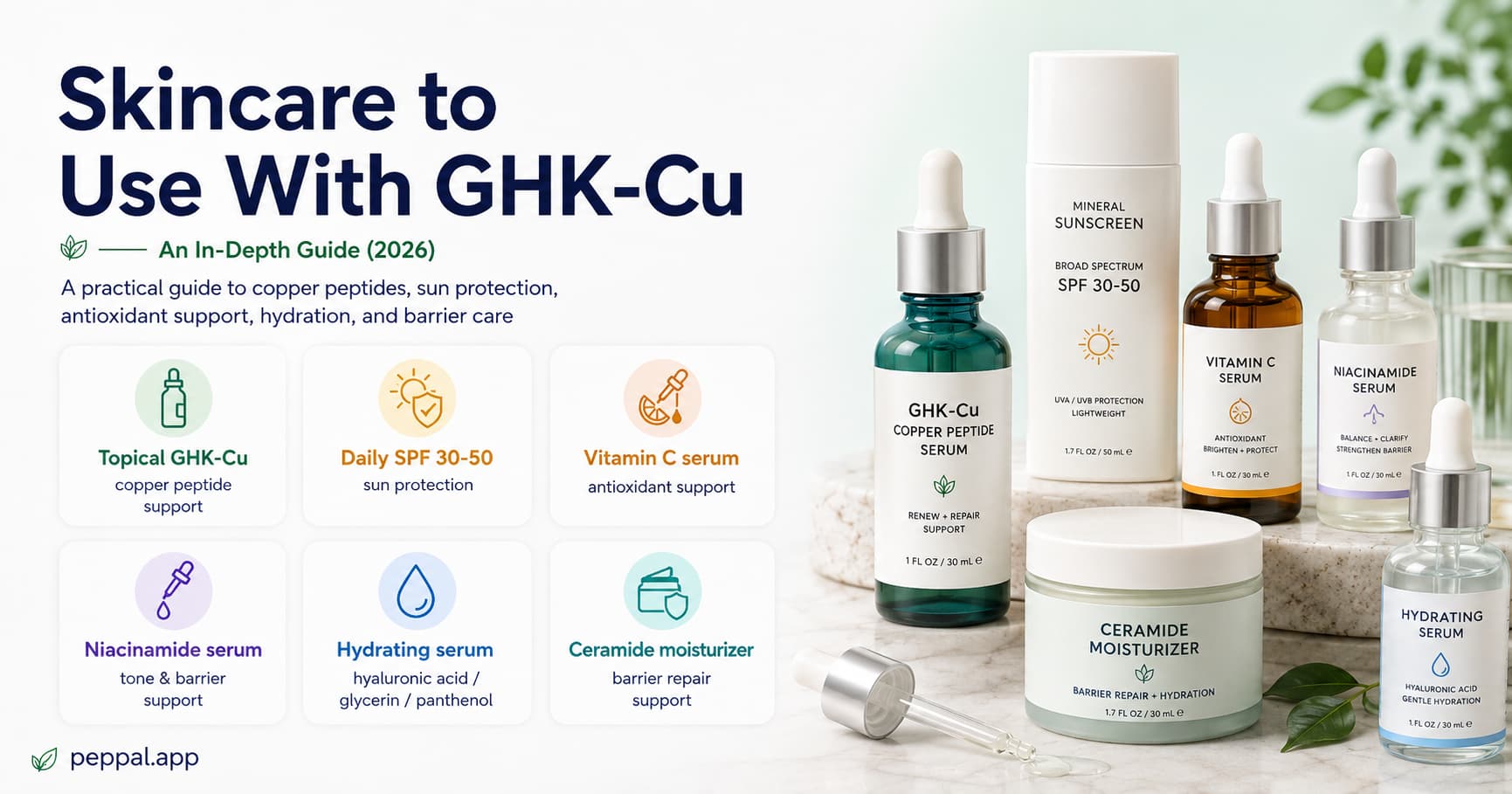
If you are already researching GHK-Cu (copper tripeptide-1) as a peptide, this page covers the topical skincare routine that pairs with it. It focuses on copper peptides and simple skin support from the outside.
This is not an injection guide. It does not cover reconstitution, dosing, cycle length, or injection frequency. For that kind of research, use our GHK-Cu guide and the peptide calculator. Here, we keep it topical and routine-focused.
This page is general education, not medical advice or a treatment plan. It does not provide injectable dosing. Patch test new topicals, introduce one active at a time, and talk to a licensed clinician before starting prescription products or any peptide.
GHK-Cu is a small copper-binding peptide your body makes naturally, and levels fall as you age. In skin care, it acts as a signaling and carrier molecule: it helps deliver copper and nudges skin cells toward repair, which is tied to collagen, elastin, and the skin's support matrix.
A 2018 review in the International Journal of Molecular Sciences (Pickart and Margolina) summarizes its roles in skin regeneration and barrier support. In a 12-week facial-cream study (Leyden and colleagues) in 71 women with photoaging, a GHK-Cu cream improved firmness, clarity, and skin density and reduced the look of fine lines. In a separate biopsy comparison, a copper-peptide cream raised collagen in more participants than vitamin C or retinoic acid creams did.
Realistic framing matters. A dermatologist review puts it well: there is real science here, but a lot of online hype too. Copper peptides are more about long-term skin quality and resilience than overnight smoothing. Claims about hair regrowth or weight loss are overstated.
Most studies and product reports show hydration and texture improving in 1-2 weeks, firmness and fine lines around 6-12 weeks, and the biggest changes building over 3-6 months of consistent use.
Since you are already looking at the injectable side, here is the honest comparison for skin specifically. The published skin-appearance studies almost all use topical creams and serums applied to the skin surface. That is where the direct cosmetic evidence lives.
Injectable GHK-Cu is studied more in systemic and regenerative research contexts and is research-use only. For visible skin support, a quality topical copper peptide is the route with the most direct data, and it is non-prescription and easy to patch test. Many people researching the peptide simply add a topical on top of whatever else they are studying.
This guide does not tell you how to dose or inject anything. If you are researching injectable protocols, keep that work in our GHK-Cu guide and peptide calculator, and talk to a licensed clinician.
You do not need ten products. A clean routine that protects the barrier and adds sun protection does most of the heavy lifting. Build it slowly.
Sun exposure undoes most anti-aging work. Daily SPF is the single highest-value step in any skin protocol, copper peptides included.
Copper peptides are friendly with gentle ingredients but can clash with strong, low-pH actives. The fix is almost always timing, not avoidance.
Copper peptides: pair vs separate
Ingredient
How to use it with copper peptides
Why
Ingredient
How to use it with copper peptides
Why
Ingredient
Ceramides / squalane
How to use it with copper peptides
Why
Ingredient
Vitamin C (pure L-ascorbic)
How to use it with copper peptides
Why
Ingredient
How to use it with copper peptides
Why
Ingredient
AHA/BHA acids
How to use it with copper peptides
Why
Add only one new active at a time, and give it about two weeks before judging it. Patch test first.
Note on freshness: GHK-Cu and retinoids are both unstable ingredients. Buy from sources with reasonable turnover, store products away from heat and light, and close caps tightly so the actives are still active when they reach your skin.
Topical copper peptides come as serums, creams, and balms. For skincare results, the format matters less than the formula. Use this checklist:
Tallow-based copper-peptide balms are a popular newer format. They are essentially a rich moisturizer carrying GHK-Cu, often with add-ins like manuka honey or methylene blue. They can feel great on dry skin, but most do not list a GHK-Cu percentage, so treat them as a nourishing moisturizer-plus rather than a precise active. If firmness is your main goal, a concentration-labeled serum is easier to judge.
Use this as a simple shopping checklist for the topical and routine layer. It is not dosing guidance and does not cover injectable GHK-Cu. Confirm product details, ingredients, and current pricing on each listing before buying.
Discount code: PEPPAL works on eligible supplier checkout links. Disclosure: some links may earn PepPal a commission at no extra cost to you.
Why choose Peptide Partners?
Disclosure: supply links may earn PepPal a commission at no cost to you.
A product page tells you more than the marketing image.
Concentration
Look for a listed GHK-Cu percentage (about 0.1-2%).
Packaging
Opaque, air-protected packaging helps stability.
Ingredients
Barrier-friendly base; go easy on fragrance.
Tretinoin
Prescription only; ask a clinician before starting.
Introduce one active at a time, patch test, and stop anything that stings or irritates. This checklist does not replace clinician guidance.
If you are researching the injectable side of GHK-Cu, keep that separate from this routine. Our GHK-Cu guide covers the peptide in more depth, the peptide calculator handles reconstitution math for research planning, and peptide injection supplies lists the basics. As always, a licensed clinician should guide anything you put under your skin.
Topical GHK-Cu has decades of small studies suggesting it can improve the look of firmness, fine lines, and skin density over about 8-12 weeks. It is one of the better-studied skincare peptides, though results are gradual and it is not a miracle ingredient.
For visible skin support specifically, topical copper peptides have the most direct evidence and are non-prescription and easy to patch test. Injectable GHK-Cu is research-use and carries more unknowns. This is not medical advice; talk to a licensed clinician about any peptide.
Yes, but not in the same step. Most people alternate nights or apply copper peptides first and wait before a retinoid, since stacking them raises irritation. Tretinoin is prescription strength, so start it only with clinician guidance.
Use them at different times. Copper can speed up the breakdown of pure L-ascorbic acid vitamin C, so the common approach is vitamin C in the morning and copper peptides at night, or on alternate days.
Avoid layering them in the same step with pure vitamin C, strong AHA/BHA acids, or retinoids. Separate those by time or day. Copper peptides pair well with hyaluronic acid, niacinamide, and ceramides.
Hydration and texture often improve in 1-2 weeks, firmness and fine lines around 6-12 weeks, and the biggest changes build over 3-6 months of consistent use. Consistency matters more than trying to find the strongest formula.
Both can work; the formula matters more than the format. Serums absorb fast and layer easily, while creams and tallow-based balms are richer for dry or mature skin. Prefer a product that lists its GHK-Cu concentration.
Yes. Tallow-based copper-peptide balms act mainly as a rich moisturizer that also carries GHK-Cu. They feel nourishing on dry skin, but most do not list a concentration, so treat them as a moisturizer-plus rather than a precise active.
Preferred supplier
Peptide PartnersNeed peptides? Start with a verified supplier.
PepPal's recommended source with current discount access and established testing standards.