
Featured Dosing Tracker
PepPal Pro
Save your calculations and follow your peptide cycle by day, week, or month.
- Peptide calendar
- Cycle tracking
- Saved calculations
Peptide Tools
Reconstitution + Units
This free calculator turns vial size, BAC water, and target dose into concentration, draw volume, and U-100 syringe units. It supports mg and mcg, and it is an educational research-planning tool, not medical advice. It does not tell you what dose to use.
Quick summary
MOTS-c presets
Use the presets first; the manual steps below are for different vial sizes, water volumes, or doses.
3 mL max presets
10 mg + 2 mL = 5 mg/mL, so 500 mcg = 10 units and 1 mg = 20 units and 5 mg = 100 units.
Mixed MOTS-c should look clear and colorless. MOTS-c is sensitive, so many sources say to refrigerate it and use it within about 2 weeks. Some sources use 0.9% saline BAC water to reduce injection-site welts.
Optional: use when your setup does not match a preset
Step 1
Choose syringe size.
Step 2
How many mg of peptides are in your vial?
Step 3
Dose amount per injection. 1 mg = 1000 mcg.
Step 4
Bacteriostatic water used to reconstitute your vial.
Featured Dosing Tracker
Save your calculations and follow your peptide cycle by day, week, or month.
This calculator does one job. It turns your vial size, the amount of BAC water you add, and your target dose into three numbers: concentration in mg/mL, the volume you draw in mL, and the matching units on a U-100 insulin syringe.
MOTS-c ships as a freeze-dried powder. Before it can be drawn into a syringe, it has to be mixed with bacteriostatic (BAC) water. The amount of water you add sets the concentration, and the concentration decides how many units you draw.
MOTS-c is dosed two ways. Some protocols use small daily amounts in mcg, and others use larger weekly amounts in mg. Because of that range, you can enter your dose in mg or mcg, and the calculator warns you if a draw is too big for one syringe.
This page and calculator are educational research-planning tools. They do not recommend a dose, diagnose, or treat anything. MOTS-c is not an FDA-approved drug and has not completed a human trial. Talk to a qualified clinician before using any peptide.
Start with the MOTS-c presets. They load common vial sizes, BAC water amounts, and dose entries. Use the custom fields only when your vial, water volume, or target dose does not match the preset you need.
Pick the MOTS-c vial setup that matches your research vial and BAC water amount. Common MOTS-c research vials are 5, 10, 20, and 40 mg.
Choose a common MOTS-c dose entry, or type your own amount. You can switch between mg and mcg, and 1 mg is the same as 1000 mcg.
If your setup does not match a preset, enter the vial size, BAC water, or dose by hand. For larger MOTS-c draws, less BAC water makes a stronger mix.
The calculator shows concentration in mg/mL, draw volume in mL, and matching U-100 syringe units. If the draw is larger than a 1 mL syringe, it will warn you.
Use Save calculation to email yourself the vial, water, dose, and unit result so you can check the math later.
The math is short. Concentration is vial size divided by BAC water. Draw volume is target dose divided by concentration. U-100 units are milliliters multiplied by 100.
Here is one example. A 10 mg vial with 2 mL of BAC water gives 5 mg/mL. A 1 mg dose is 1 divided by 5, which is 0.2 mL, or 20 units. But a 5 mg dose at that same 5 mg/mL is 1.0 mL, which fills a whole 1 mL syringe. For doses that big, add only 1 mL of water for a stronger 10 mg/mL mix.
Concentration and units per 1 mg by vial size and BAC water
Vial size
5 mg
BAC water
Concentration
Units per 1 mg
Vial size
5 mg
BAC water
Concentration
Units per 1 mg
Vial size
10 mg
BAC water
Concentration
Units per 1 mg
Vial size
10 mg
BAC water
Concentration
Units per 1 mg
Vial size
10 mg
BAC water
Concentration
Units per 1 mg
Vial size
20 mg
BAC water
Concentration
Units per 1 mg
Vial size
40 mg
BAC water
Concentration
Units per 1 mg
10 mg + 2 mL (5 mg/mL) is the most documented mix. Because weekly MOTS-c doses can be large, mix at 10 mg/mL when you plan 5 mg or 10 mg doses so the draw stays under 1 mL.
MOTS-c shows up in research planning two ways. Some sources use small daily amounts, often 0.2 to 1 mg. Others use larger weekly amounts, often 5 to 10 mg, sometimes split or timed before exercise. We list these numbers because people search for them. This is not a dose recommendation, and the calculator does not tell you which dose to use.
Below is how common doses convert to U-100 syringe units at two research concentrations. Remember 1 mg equals 1000 mcg.
Units to draw at 5 mg/mL (e.g. 10 mg vial + 2 mL)
Dose
500 mcg (0.5 mg)
Volume (mL)
U-100 units
Dose
1 mg
Volume (mL)
U-100 units
Dose
5 mg
Volume (mL)
U-100 units
Dose
10 mg
Volume (mL)
U-100 units
This mix is clean for small doses, but a 5 mg dose fills the whole syringe and 10 mg will not fit. For weekly mg-size doses, mix stronger.
Units to draw at 10 mg/mL (e.g. 10 mg vial + 1 mL)
Dose
500 mcg (0.5 mg)
Volume (mL)
U-100 units
Dose
1 mg
Volume (mL)
U-100 units
Dose
5 mg
Volume (mL)
U-100 units
Dose
10 mg
Volume (mL)
U-100 units
A 10 mg/mL mix keeps the larger weekly doses inside one syringe. Small daily doses become tiny here, so a 0.3 mL syringe is easier for those.
MOTS-c is a small peptide your mitochondria make. Research describes it as an exercise-like signal that switches on a cell pathway called AMPK, which is the same pathway exercise and the drug metformin use. That is why it is studied for metabolism, body composition, and aging. These are research findings, not proven results in people.
MOTS-c is written in mg for weekly doses and sometimes mcg for small daily doses. 1 mg equals 1000 mcg, so 0.5 mg is 500 mcg. Always check the unit before you draw, and the calculator accepts either.
MOTS-c often causes a red, raised welt at the injection site. To reduce that, some sources mix it with 0.9% saline (sodium chloride) bacteriostatic water instead of plain BAC water, and inject slowly. Rotating sites also helps. This is a handling note, not medical advice.
Add the water slowly down the side of the vial and swirl gently. Do not shake. Mixed MOTS-c should look clear. MOTS-c is more sensitive than some peptides, so many sources say store it in the refrigerator and use it within about 2 weeks. Do not freeze a mixed vial. A 10 mg vial gives two 5 mg doses or ten 1 mg doses.
Use this as a simple shopping checklist for reconstitution. Confirm vial size, batch documents, and current pricing before ordering. This is not dose advice.
PEPPAL applies to eligible supplier checkout links when supported by the supplier.
Why choose Orbitrex Peptides?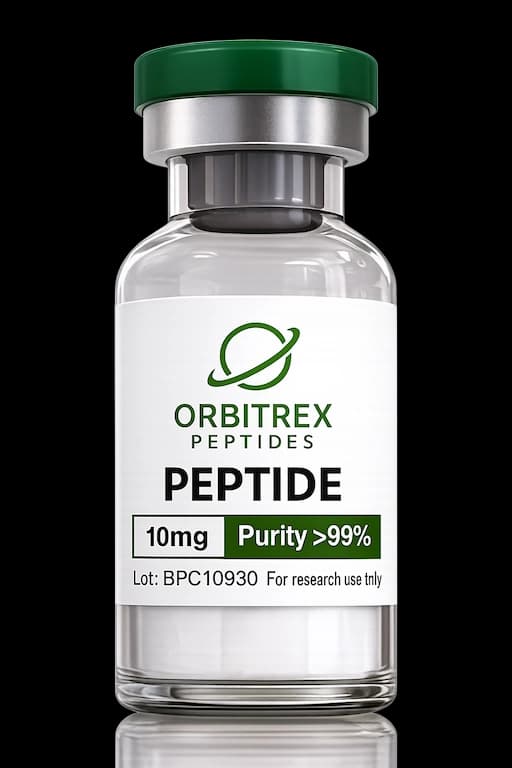
Disclosure: supply links may earn PepPal a commission at no cost to you.
It converts vial size, BAC water, and target dose into concentration (mg/mL), draw volume (mL), and U-100 syringe units. It accepts mg or mcg. It does not tell you what dose to use.
Yes. It runs in your browser at no cost and does not require an account.
It depends on the concentration you want. A 10 mg vial with 2 mL of BAC water makes 5 mg/mL, which is the most documented mix. Using 1 mL makes 10 mg/mL for larger doses. Enter your numbers and the calculator shows the result.
At 5 mg/mL it is 100 units, which fills a whole 1 mL syringe. At 10 mg/mL it is 50 units. For larger doses, mix stronger so the draw stays small. Check your own mix in the calculator.
MOTS-c weekly doses are large, so a weak mix makes a big draw. At 5 mg/mL a 5 mg dose fills a full syringe and 10 mg will not fit. Use less BAC water for a stronger mix.
Injection-site redness and welts are a common, usually mild MOTS-c reaction. Some sources mix it with 0.9% saline bacteriostatic water, inject slowly, and rotate sites to reduce it. This is a handling note, not medical advice.
MOTS-c is sensitive, so many sources say store it in the refrigerator and use it within about 2 weeks. Do not freeze a mixed vial. Keep the dry powder cold and dark until you mix it.
Native MOTS-c has not completed a human efficacy trial. The closest human safety data is for a related analog called CB4211, which is similar but not the same molecule. Most evidence comes from mouse and cell studies.
No. MOTS-c is not FDA-approved and is sold as a research-use-only peptide. Athletes should also check anti-doping rules before use.
No. This calculator is for education and research planning only. It does not diagnose, treat, or recommend a dose. Talk to a qualified clinician before using any peptide.
Preferred supplier
Peptide PartnersNeed peptides? Start with a verified supplier.
PepPal's recommended source with current discount access and established testing standards.
The landmark paper that identified MOTS-c and showed AMPK-driven metabolic effects in mouse and cell models.
Shows MOTS-c rises with exercise in humans and improved physical capacity in aged mice — the basis for the 'exercise mimetic' framing.
Summarizes the preclinical mechanism and metabolic research and the limits of current human evidence.
Independent review noting the analog Phase 1 safety signal and the common injection-site reaction pattern.
Technical reference for reconstitution and storage best practices used in the handling section.