Step 1
Enter Your Vial Details
Input the peptide amount (mg) from your vial label and the volume of bacteriostatic water (mL) you plan to add. The calculator computes the resulting concentration in mcg/mL.

Enter your vial size, BAC water volume, and target dose — get exact syringe units in seconds with the free calculator, live now.
PepPal Premium is coming soon with saved calculations, notes, and protocol tracking. Works with Tirzepatide, Semaglutide, BPC-157, and every reconstituted peptide.
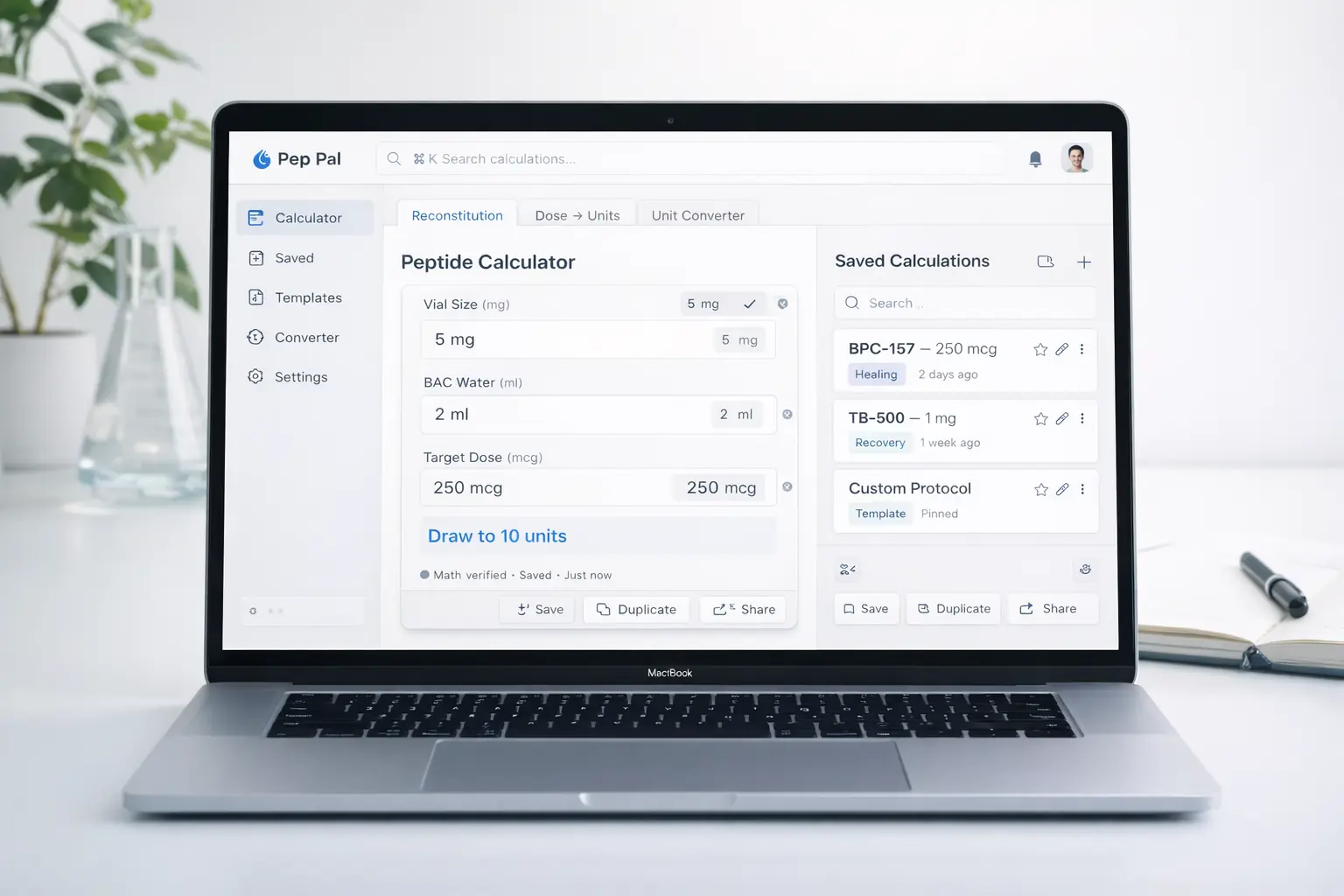
Step 1
Input the peptide amount (mg) from your vial label and the volume of bacteriostatic water (mL) you plan to add. The calculator computes the resulting concentration in mcg/mL.
Step 2
Enter the dose you need in micrograms (mcg) or milligrams (mg). The calculator converts this to the exact volume and syringe units for your insulin syringe — whether you use a 0.3 mL, 0.5 mL, or 1.0 mL U-100 syringe.
Step 3
See the precise number of units to pull on your syringe. PepPal Premium is coming soon with saved calculations, custom names, and notes. Join the waitlist for early access.
This peptide reconstitution calculator works for any lyophilized peptide mixed with bacteriostatic or sterile water. No matter which peptide you are working with, the math is the same: vial amount, water volume, and target dose determine your syringe draw.
Tirzepatide (Mounjaro / Zepbound), Semaglutide (Ozempic / Wegovy), Liraglutide (Saxenda), Retatrutide, Survodutide, and CagriSema.
BPC-157, TB-500, Thymosin Beta-4, GHK-Cu, and KPV.
CJC-1295, Ipamorelin, Tesamorelin, GHRP-6, GHRP-2, Sermorelin, MK-677 (Ibutamoren), and AOD-9604.
Semax, Selank, PT-141, Melanotan II, DSIP, Epithalon, and Thymalin.
New to reconstitution? Start with the step-by-step reconstitution guide. Looking for dosing protocols? See the full peptide list and protocol library.
Enter vial amount, BAC water volume, and target dose to get concentration and exact syringe units instantly. Supports mcg and mg inputs with automatic conversion.
Save each reconstitution with a custom name and notes so you can revisit it without re-entering values. PepPal Premium coming soon.
Already know your target units? Enter syringe units and PepPal calculates the water volume needed for that exact pull.
Support for 0.3 mL, 0.5 mL, and 1.0 mL U-100 insulin syringes with accurate unit scaling.
Load common configurations for Retatrutide, Tesamorelin, and BPC-157 in one tap. No manual data entry needed.
Log doses, track protocols over time, and keep complete history in one timeline.
Prefer to test the math first? Run the free peptide reconstitution calculator — no signup required.
| Feature | Free | PepPal Premium (Coming soon) |
|---|---|---|
| Reconstitution calculator | Yes | Yes |
| All syringe sizes | Yes | Yes |
| Preset examples | Yes | Yes |
| Reverse calculator | Yes | Yes |
| Save calculations | - | Coming soon |
| Custom names and notes | - | Coming soon |
| Access from any device | - | Coming soon |
| Dose tracking and history | - | Coming soon |
| Protocol scheduling | - | Coming soon |
The free peptide calculator is always free. PepPal Premium is coming soon for saved history and protocol tracking.
Peptide reconstitution is the process of dissolving a freeze-dried (lyophilized) peptide powder into a liquid solution so it can be measured and administered accurately. Research peptides ship as a dry powder in small vials, typically containing 5 mg, 10 mg, 15 mg, or 20 mg of peptide. Before use, you add bacteriostatic water (BAC water) to the vial to create a solution at a known concentration.
The math behind every peptide reconstitution calculator comes down to three values:
Concentration = Peptide amount (mcg) ÷ Water volume (mL)
Once you know the concentration, calculating your syringe draw is straightforward:
Dose volume = Desired dose (mcg) ÷ Concentration (mcg/mL)
Syringe units = Dose volume (mL) × 100 (for U-100 insulin syringes)
You have a 10 mg vial and add 2 mL of BAC water:
Pull your syringe to the 5-unit mark. That is your 250 mcg dose.
Adding more water creates a less concentrated solution, which makes small doses easier to measure accurately. Adding less water creates a more concentrated solution, which means fewer injections per vial but smaller, harder-to-read syringe draws.
Peptide doses are measured in micrograms — one-thousandth of a milligram. A small error in water volume or syringe reading can mean a significant percentage difference in the actual dose delivered. The PepPal peptide calculator eliminates this math entirely: enter your three values and get the exact syringe units to draw. No conversion tables, no mental math, no room for error.
A peptide reconstitution calculator converts three inputs — the peptide amount in your vial (mg), the volume of bacteriostatic water you add (mL), and your desired dose (mcg or mg) — into the exact number of syringe units to draw on an insulin syringe. It eliminates manual math and unit conversion errors.
Yes. The PepPal peptide reconstitution calculator is completely free with no signup required. You can calculate concentration, dose volume, and syringe units for any peptide at any vial size. PepPal Premium is coming soon with saved calculations, custom names, and notes.
Every reconstituted peptide. The math is universal for any lyophilized peptide mixed with bacteriostatic or sterile water, including Tirzepatide, Semaglutide, Retatrutide, BPC-157, TB-500, CJC-1295, Ipamorelin, Tesamorelin, AOD-9604, GHK-Cu, and others.
First, calculate your concentration: divide the vial amount (in mcg) by the water volume (in mL). Then divide your desired dose by that concentration to get dose volume in mL. Multiply by 100 for U-100 syringe units. Example: 10 mg vial + 2 mL water = 5,000 mcg/mL. A 250 mcg dose = 0.05 mL = 5 units.
PepPal supports 0.3 mL (30 units), 0.5 mL (50 units), and 1.0 mL (100 units) U-100 insulin syringes. These are the three most common sizes used for peptide administration.
Yes. PepPal can email your saved dose details so you can revisit past reconstitutions without re-entering values. Full in-app saved history, custom names, notes, and protocol tracking are rolling out with PepPal Premium.
It depends on your desired concentration and how easy you want the dose to measure. Adding more water makes each unit on your syringe represent a smaller dose, which improves measurement accuracy for small doses. Common volumes are 1 to 3 mL. Use the PepPal calculator to test different water volumes and see how they affect your syringe draw.
PepPal maintains a COA-verified supplier directory with Finnrick Analytics testing data, quality ratings, and discount codes. Start with our supplier comparison guide for an overview.
Need peptides after running your reconstitution math? PepPal maintains a directory of COA-verified suppliers tested by Finnrick Analytics. Compare quality ratings, pricing, and discount codes. See how PepPal evaluates suppliers before you compare vendors.
Use code PEPPAL at checkout for available discounts.
PepPal Premium is coming soon. The full tracking layer includes saved calculations, dose logging with date and injection site, protocol scheduling for multi-week titration plans, cycle management, and progress notes. Follow rollout updates on the PepPal blog.
Join the waitlist for early access
Stop re-entering the same vial amount, water volume, and dose every time you prep. The PepPal peptide reconstitution calculator gives you exact syringe units in seconds today. PepPal Premium is coming soon with saved calculations, notes, and protocol tracking.